

Blog
Blog
Blog
10 Best Air Dryers for Industrial Use in 2026?
Industrial plants rarely notice moisture until it damages something expensive. A wet airline can rust inside, contaminate instruments, and freeze near a pressure drop. That is why selecting the right air dryer deserves more than a catalog comparison. In this guide, we examine the 10 best air dryers for industrial use in 2026. The review considers dew point, flow capacity, pressure loss, energy consumption, maintenance access, and operating environment.
The U.S. Department of Energy reports that compressed-air systems may consume about 10% of industrial electricity. Its efficiency guidance also notes that leaks can waste 20% to 30% of compressor output. These figures make dryer efficiency a practical financial concern, not a technical footnote. Refrigerated models may suit general manufacturing. Desiccant systems usually serve lower dew-point requirements. Membrane dryers can help where space and simplicity matter. Still, no single air dryer fits every plant.
Frank Moskowitz, a recognized compressed-air specialist and former CAGI president, has described compressed air as “the fourth utility.” His observation remains useful because production often depends on clean, stable air. We will compare real operating details, including purge-air loss, filter replacement, drain reliability, and performance during temperature swings. Some published efficiency claims look impressive. They may not survive a dusty floor, poor ventilation, or irregular maintenance. That is an uncomfortable limitation. Therefore, this selection combines manufacturer specifications with industry guidance and practical judgment, helping buyers question attractive numbers before approving a purchase.
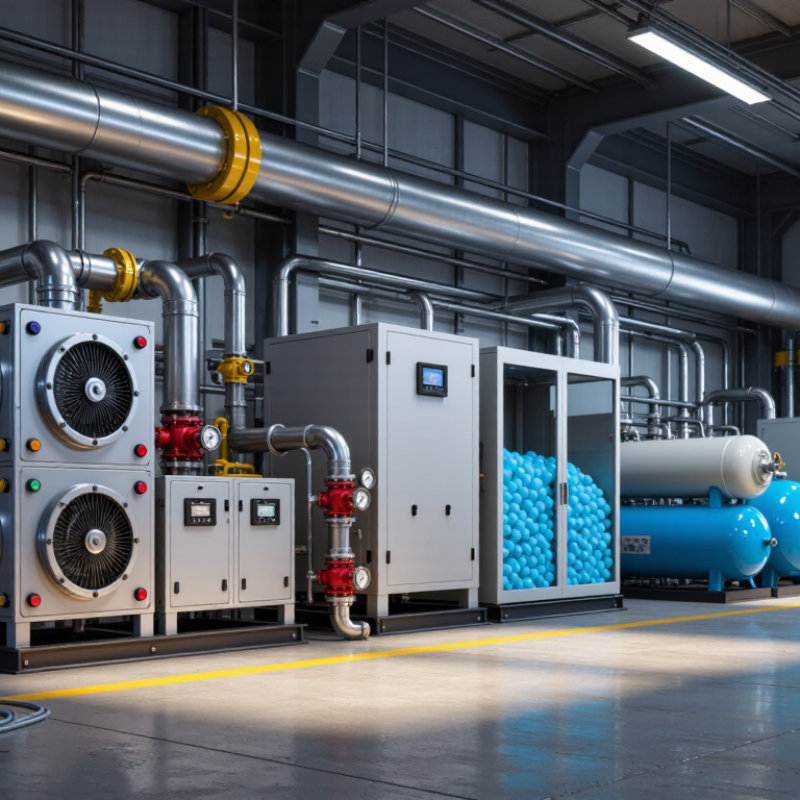
Industrial Air Dryers Explained: Types, Roles, and ISO 8573-1 Standards
Industrial air dryers protect valves, instruments, paint lines, and finished products from compressed-air moisture. Refrigerated dryers cool air near 3°C pressure dew point, while desiccant dryers can reach -40°C or lower. Membrane dryers suit smaller flows and remote installation points, although their purge-air demand deserves close attention.
The U.S. Department of Energy reports that compressed-air systems can consume about 10% of industrial electricity. Its guidance also estimates that leaks may waste 20–30% of compressor output. Therefore, selecting a dryer only by purchase price is a weak engineering decision. Flow rate, inlet temperature, ambient conditions, pressure loss, and regeneration energy matter more during daily operation.
ISO 8573-1 defines air purity through particles, water, and oil classes. For example, ISO water Class 2 allows a pressure dew point of -40°C, while Class 4 allows +3°C. Oil Class 1 limits total oil to 0.01 mg/m³. These limits should match the process, not marketing language. A food-contact line, pneumatic actuator, and laboratory instrument may require different treatment.
Sometimes, that assumption fails. Measuring pressure dew point and downstream contamination is essential. Filters also need correct maintenance; an overloaded filter can quietly increase energy use and reduce available pressure. My practical concern is simple: even a well-sized dryer may underperform when installation data are incomplete.
Key Selection Metrics: Pressure Dew Point, Flow Rate, and Energy Use
10 Best Air Dryers for Industrial Use in 2026?
Selecting among the ten best industrial air dryers requires more than comparing purchase prices. Pressure dew point should match the application. General plant air often uses refrigerated drying near +3°C, while instruments and outdoor lines may require approximately -40°C. ISO 8573-1 classification helps define the moisture risk, but site temperature changes can expose weak choices. Numbers can mislead.
Flow rate must reflect actual demand at operating pressure, not only the advertised free-air delivery. A dryer rated for 1,000 scfm may struggle when inlet air reaches 40°C or when filters become loaded. During plant audits, I would record peak flow, average flow, pressure drop, and seasonal temperature. A small buffer can help. Oversizing is not automatically efficient.
Energy deserves equal weight. The U.S. Department of Energy reports that compressed air can consume roughly 10% of industrial electricity, while poorly maintained systems may lose 20–30% of compressor output through leaks. The DOE’s Improving Compressed Air System Performance sourcebook recommends checking controls, pressure losses, and part-load behavior. Compare specific power, expressed as kW per 100 scfm, under realistic conditions. Laboratory data remains useful, but dusty floors, hot rooms, and wet intake air may change performance. Recheck after installation.
Comparing 10 Best Dryers by PDP, CFM, Pressure, and Efficiency Data
Selecting the 10 best air dryers for industrial use in 2026 requires more than comparing purchase prices. The practical shortlist includes refrigerated, desiccant, membrane, deliquescent, and hybrid designs. Each unit should be tested at the same inlet temperature, ambient temperature, pressure, and airflow. Otherwise, the data becomes misleading.
Pressure dew point, or PDP, remains the key specification. A PDP of 3°C suits general plant air, while sensitive processes may require -40°C or lower.
CFM must match actual demand, not the compressor’s advertised output. Check airflow at operating pressure, because capacity often falls as pressure changes. Pressure loss matters too. A dryer causing a 0.3 bar drop can increase compressor workload throughout the year. In field assessments, I also record purge-air consumption, electrical demand, drain performance, and recovery time. These details reveal weaknesses that brochures may hide.
For the ten leading candidates, efficiency should be compared through energy used per delivered CFM, not only motor wattage. Refrigerated units usually use less energy for stable, moderate PDP requirements. Desiccant systems can reach much drier air, but heater power and purge losses need careful review. Membrane systems are compact, although their airflow limits may disappoint large plants. Small errors remain possible when weather and load fluctuate. A dryer that performs well during a factory test may struggle beside a hot compressor room. Maintenance access, sensor calibration, filter condition, and verified pressure ratings deserve equal attention.
Numbers matter. Operating conditions matter more.
Industrial Applications: Food, Pharma, Electronics, and Heavy Manufacturing
10 Best Air Dryers for Industrial Use in 2026?
Industrial air dryers must match the process, not only the compressor size. Food plants often need clean, dry air near filling lines, conveyors, and packaging machines. Refrigerated dryers suit general production, while desiccant dryers support lower dew points for sensitive processes. Moisture can spoil powdered ingredients, block valves, and encourage microbial growth. Small leaks matter too.
Pharmaceutical facilities require documented performance, validated filtration, and stable pressure dew points. Dryers should support oil-free air systems and consistent operation during batch changes. Electronics factories face another risk: condensation can damage circuit boards, sensors, and precision tools. Desiccant or membrane technology may be appropriate when very dry air reaches assembly zones. Check ISO 8573-1 requirements before selecting equipment.
Heavy manufacturing needs durability around welding cells, stamping lines, abrasive dust, and temperature swings. A high-capacity refrigerated dryer may lower operating costs, but it cannot solve every moisture problem. Desiccant systems offer stronger drying, though regeneration consumes energy and requires careful maintenance. That trade-off is easy to underestimate. Service access, drain reliability, pressure loss, noise, and spare-part availability should influence any 2026 shortlist. A technically impressive dryer can still fail when filters are ignored or drains remain unchecked. The best choice is often less glamorous.
| Rank | Industrial Air Dryer Configuration | Typical Flow Range | Typical Pressure Dew Point | Typical Operating Pressure | Approximate Energy Profile | Best Industrial Applications | Key Advantages | Important Selection Limits |
|---|---|---|---|---|---|---|---|---|
| 1 | Cycling Refrigerated Dryer | 1–500 Nm³/min | +3°C to +5°C | 4–16 barg | Low to moderate; refrigeration compressor cycles with load | General plant air, food packaging, non-sterile processing, metalworking, and heavy manufacturing | Good energy efficiency at variable demand; stable outlet dew point; low operating complexity | Not suitable where sub-zero dew points are required; requires clean condensate management |
| 2 | Non-Cycling Refrigerated Dryer | 0.2–300 Nm³/min | +3°C to +7°C | 4–16 barg | Moderate; refrigeration circuit runs continuously | Stable-load workshops, assembly plants, general pneumatic tools, and utility air systems | Simple design; economical purchase cost; easy maintenance; reliable for steady air demand | Higher energy use at low or fluctuating load; cannot reliably prevent condensation below its dew point |
| 3 | High-Inlet-Temperature Refrigerated Dryer | 1–250 Nm³/min | +3°C to +10°C | 4–16 barg | Moderate; includes enhanced cooling or pre-cooling | Hot compressed-air systems, foundries, steel plants, outdoor installations, and heavy-duty process air | Handles elevated inlet temperatures better than standard refrigerated units; reduces aftercooler requirements | Requires correct ventilation and condensate drainage; not intended for instrument air below 0°C |
| 4 | Heatless Twin-Tower Desiccant Dryer | 0.1–150 Nm³/min | −40°C, optional −70°C | 4–16 barg | Low electrical demand, but typically 12–18% purge-air consumption | Pharmaceutical utilities, outdoor instrument air, pneumatic control systems, and cold-climate installations | Very low dew points; no external heating system; effective for freeze protection | Purge air reduces delivered capacity; desiccant is sensitive to liquid water and oil carryover |
| 5 | Heated Purge Desiccant Dryer | 5–500 Nm³/min | −40°C, optional −70°C | 4–16 barg | Moderate; typically 3–7% purge air plus heater power | Large pharmaceutical plants, electronics manufacturing, dry-process production, and continuous-duty utilities | Lower purge loss than heatless designs; suitable for high flow and continuous operation | Higher capital cost; requires heater controls, maintenance, and adequate regeneration time |
| 6 | Blower Purge Desiccant Dryer | 20–1,000 Nm³/min | −40°C, optional −70°C | 4–16 barg | Low purge loss; blower and heater consume electrical power | Large-scale food, pharmaceutical, electronics, chemical, and semiconductor support systems | Minimal product-air purge; efficient for high-capacity systems; consistent deep drying | Larger footprint; more controls and moving equipment; requires reliable electrical power |
| 7 | Heat-of-Compression Desiccant Dryer | 50–1,500 Nm³/min | −20°C to −40°C | 4–16 barg | Very low additional energy when paired with high-temperature oil-free compression | Large oil-free compressor installations, pharmaceutical air, electronics plants, and high-volume process air | Uses compressor discharge heat for regeneration; little or no purge-air loss; excellent at large scale | Best suited to oil-free compressors with suitable discharge temperature and stable operating profiles |
| 8 | Membrane Air Dryer | 0.01–20 Nm³/min | Typically −20°C to −40°C | 5–12 barg | No electrical power; uses approximately 10–25% sweep or purge air | Point-of-use instrument air, electronics assembly, laboratory equipment, and remote pneumatic controls | Compact; no moving parts; quiet operation; suitable for remote or hazardous locations | Limited flow capacity; requires high-quality pre-filtration; purge-air loss can be significant |
| 9 | Deliquescent Desiccant Dryer | 0.1–100 Nm³/min | Usually 10°C to 15°C below inlet temperature | 4–16 barg | No electrical power; consumes replaceable desiccant material | Temporary air systems, construction sites, remote heavy equipment, and non-critical outdoor service air | Simple installation; no electrical connection; low initial cost; tolerant of intermittent operation | Not generally preferred for pharmaceutical or electronics air; chemical carryover and consumable replacement must be controlled |
| 10 | Refrigerated Dryer with Integrated Coalescing Filtration | 1–400 Nm³/min | +3°C to +5°C | 4–16 barg | Low to moderate; refrigeration power varies with load | Food and beverage packaging, general pharmaceutical utilities, paint lines, clean assembly, and plant-wide air networks | Combines moisture removal with improved aerosol and particulate control; saves installation space | Filtration elements require scheduled replacement; does not provide the deep dew point of adsorption dryers |
Engineering note: The figures shown are representative industrial design ranges rather than manufacturer-specific ratings. Actual performance depends on flow, inlet temperature, ambient conditions, operating pressure, compressor type, filtration, and the required air-quality class under ISO 8573-1.
2026 Buying Framework: Capacity, Lifecycle Cost, Maintenance, and Compliance
Choosing the 10 best air dryers for industrial use in 2026 requires more than comparing purchase prices. Start with actual airflow demand, measured in cubic feet per minute, and include future production growth. A dryer running near its limit may create pressure loss, wet pipelines, and unstable tools. Check the required pressure dew point for the process. Packaging, painting, and outdoor instruments usually need stricter moisture control than general workshop equipment.
Capacity must match real operating conditions, not brochure figures. Inlet temperature, ambient heat, pressure, and seasonal humidity can change performance. I have seen systems selected from average load data, then overloaded during summer shifts. That mistake was expensive. Leave practical headroom, but avoid extreme oversizing. An oversized dryer can waste energy during low-demand periods.
Lifecycle cost deserves equal attention. Calculate electricity, filters, drains, cooling water, service labor, and expected downtime over several years. A low-cost unit may need frequent filter replacement or complicated cleaning. Ask how technicians will access drains and heat exchangers when the floor is crowded. Maintenance records should show service intervals, alarm functions, and spare-part availability. Digital monitoring helps, but only when someone reviews the data.
Compliance also matters. Confirm pressure equipment requirements, electrical safety rules, emissions limits, and site-specific quality standards before installation. Documentation should include test results, operating limits, manuals, and maintenance procedures. Do not accept vague claims such as “oil-free air” without defined testing conditions. A reliable shortlist reflects measured plant data, verified service support, and the consequences of moisture reaching the final product.