

2026 Top Hotel Bed Sheet Set Suppliers for Global Buyers
Choosing the right Hotel Bed Sheet Set supplier can shape guest comfort, operating costs, and brand reputation in 2026. Global buyers now examine more than thread count. They compare fiber quality, stitching, sizing accuracy, packaging, lead times, and responsible production practices.
A practical supplier review starts with real hotel conditions. Sheets must survive frequent washing, commercial dryers, folding, and repeated room turnover. Cotton, polyester blends, bamboo-based fabrics, and recycled fibers can perform differently under heat and chemical exposure. A reliable supplier should provide clear specifications, fabric samples, test reports, and consistent communication. Buyers should also confirm whether measurements match regional mattress standards.
Small details matter. Inspect the hem. Feel the fabric after washing. Check the fitted sheet’s elastic recovery. These steps reveal more than attractive catalog photographs. Suppliers serving international markets should explain production capacity, quality-control procedures, export packaging, and documentation. Independent verification remains valuable, especially when sustainability or performance claims appear broad.
No ranking is flawless. Supplier strengths may change with raw material prices, factory workloads, or shipping disruptions. Some businesses also publish limited information, creating uncertainty for careful buyers. This guide presents a practical comparison of leading 2026 suppliers, based on product range, manufacturing experience, quality evidence, customization options, communication, and global fulfillment capability. It is designed to support informed decisions, not replace sampling and due diligence. A promising quotation is only a starting point. Reliable results come from testing the product before placing a large order.
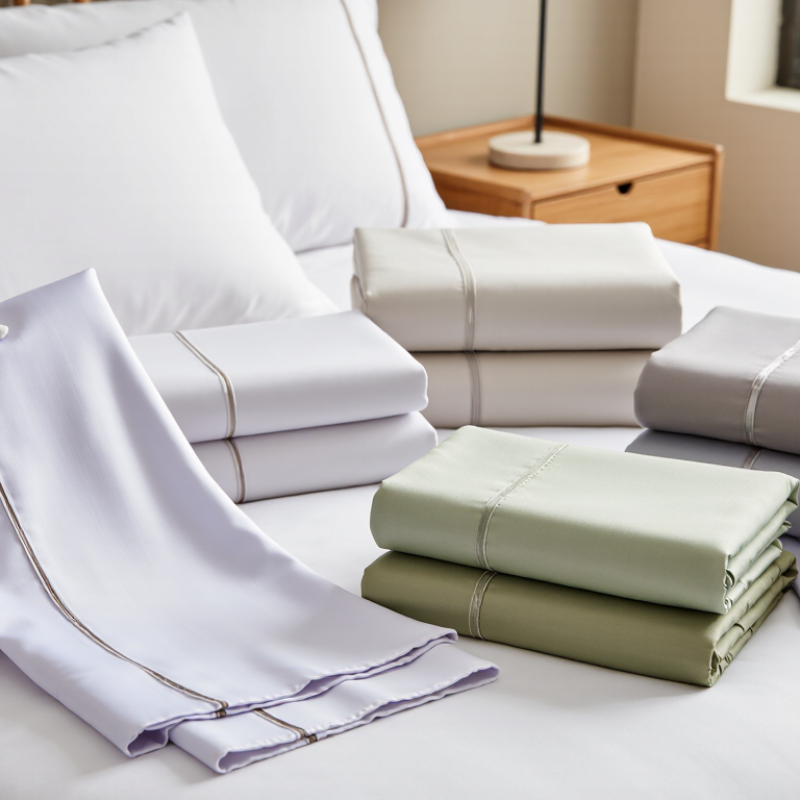
Hotel Bed Sheet Sets: Materials, Specifications, and Industry Standards
Hotel bed sheet sets are judged by more than softness. Global buyers need materials that perform after repeated washing, drying, and guest use. Combed cotton offers breathability and a familiar hand feel. Polyester blends usually improve drying speed, shape retention, and cost control. Some suppliers use cotton-rich blends for balanced comfort and durability.
Specifications should match the hotel’s operating model. Common details include fitted sheet depth, flat sheet dimensions, pillowcase size, fabric weight, weave, and finished shrinkage. Thread count can help comparison, but it should not replace fabric testing. A dense percale may feel cooler, while sateen often feels smoother and warmer. GSM gives another useful measurement. Still, numbers can mislead when yarn quality is weak.
Quality checks should cover seam strength, colorfastness, pilling, dimensional stability, and wash performance. Test methods should be documented and traceable. Buyers may request laboratory reports for restricted substances, skin-contact safety, and fiber composition. Fire-safety requirements differ by country and hotel type, so suppliers must confirm the target market before production. In practice, a 3% shrinkage allowance can affect room presentation. Small errors become visible on tightly made beds. A perfect specification rarely exists. I would rather see honest test limits than polished claims without evidence. Some purchasing teams still overvalue thread count and underestimate laundering conditions. That mistake can be expensive.
| Data Category | Specification or Supplier Capability | Typical Commercial Range or Requirement | Buyer Evaluation Criteria | Relevant Standards, Tests, or Notes |
|---|---|---|---|---|
| Material and Construction Options | ||||
| 100% Cotton | Natural cellulose fiber with good moisture absorption, breathability, and laundering performance. | Commonly supplied in percale, sateen, or plain-weave constructions; fabric weight is often approximately 110–180 g/m² for hotel sheets. | Check fiber composition, fabric weight, shrinkage, colorfastness, pilling, and seam durability. | Fiber composition may be verified by ISO 1833. Wash testing can follow ISO 6330 with dimensional change assessed under ISO 5077. |
| Cotton-Polyester Blend | Blend combining cotton comfort with polyester strength, faster drying, and improved dimensional stability. | Typical hotel constructions include 50/50 or 60/40 cotton/polyester blends, although exact ratios vary by program. | Suitable for high-turnover laundries; verify the declared blend ratio and heat-drying performance. | Composition testing under ISO 1833; colorfastness and laundering procedures should be agreed before approval. |
| Polyester Microfiber | Fine synthetic polyester yarns offering quick drying, low wrinkling, and generally lower purchase cost. | Often supplied at approximately 80–120 g/m² for lightweight commercial bedding. | Assess static tendency, breathability, pilling, oil absorption, odor retention, and guest comfort. | Polyester identification can be tested under ISO 1833. Performance claims should be supported by laboratory reports. |
| Organic Cotton | Cotton produced under an organic-farming certification system and processed through a certified supply chain. | Usually specified with a recognized organic-content certification and a documented transaction or chain-of-custody system. | Confirm certification scope, product certificate validity, labeling permissions, and percentage of certified fiber. | Organic claims require certification under an accepted scheme such as GOTS or another applicable legal and buyer-approved system. |
| Lyocell or Cotton-Lyocell Blend | Cellulosic fiber known for a smooth hand feel and moisture-management properties; often blended with cotton. | Common blend proportions vary according to the required softness, cost, and laundering profile. | Review wet-strength behavior, dimensional stability, seam performance, and compatibility with commercial ironing. | Fiber composition should be verified under ISO 1833; supplier claims should identify the exact fiber type and blend percentage. |
| Weave Structure | Percale generally has a crisp, matte hand; sateen generally has a smoother, silkier surface. | Percale is often specified at a minimum of 180–200 thread count for hospitality programs, while premium programs may specify higher values. | Do not use thread count alone; inspect yarn size, weave density, fabric weight, finish, and actual hand feel. | Thread-count measurement methods should be defined in the purchase specification because counting practices can differ. |
| Hotel Sheet Set Specifications | ||||
| Standard Set Components | Typical set may include one flat sheet, one fitted sheet, and two pillowcases for a double or king-size bed. | Component count should be stated per set, carton, and room; pillowcase quantity may vary by hotel operating model. | Confirm whether duvet covers, mattress protectors, pillow protectors, and decorative shams are included or sold separately. | Use a signed packing list and approved pre-production sample to control component consistency. |
| Common Mattress Sizes | Typical international reference sizes include Twin, Full/Double, Queen, King, and California King. | Actual dimensions vary by country and hotel group. Fitted-sheet dimensions must match mattress width, length, and depth. | Provide finished dimensions in centimeters and inches, including mattress-pocket depth and elastic allowance. | There is no single global hotel-bed size standard; the buyer's mattress measurement must control production. |
| Fitted-Sheet Pocket Depth | Finished pocket depth designed to cover the mattress and any approved topper or mattress pad. | Common commercial specifications range from approximately 30–45 cm, but deeper pockets may be required for pillow-top mattresses. | Test fit on the actual mattress stack after laundering, not only on a flat measurement table. | Specify finished depth after washing and define acceptable tolerance, commonly around ±2–3 cm depending on the contract. |
| Flat-Sheet Allowance | Additional fabric provided for side and end tuck-in. | Allowance depends on mattress height, bed-making method, and housekeeping preference; a practical specification commonly adds 60–90 cm to the mattress length. | Validate tuck-in security, appearance, and ease of bed making during a housekeeping trial. | Final dimensions should be approved after laundering because cotton products may shrink. |
| Hem Construction | Double-fold hems at sheet ends and reinforced openings on pillowcases. | Commercial specifications often use approximately 2–5 cm finished hems, with reinforced stitching at stress points. | Check stitch density, skipped stitches, loose threads, bartacks, and seam slippage. | Seam strength and seam slippage may be evaluated using applicable ISO or ASTM textile test methods agreed in the technical file. |
| Elastic and Corner Design | Full-perimeter elastic, corner elastic, or elasticized fitted-sheet construction. | Full-perimeter elastic generally provides stronger mattress retention during repeated housekeeping use. | Inspect elastic recovery after laundering and confirm that the sheet does not detach from the mattress corners. | Elastic performance should be tested after the buyer-defined wash-and-dry cycle. |
| Color Range | White is the most common hotel color because it supports visual cleanliness checks and commercial bleaching protocols where permitted. | Other colors may be offered using a buyer-approved color standard or laboratory-dipped swatch. | Evaluate color change, staining, chlorine or oxygen bleach tolerance, and lot-to-lot shade consistency. | Colorfastness may be tested using ISO 105 series methods or equivalent buyer-approved methods. |
| Dimensional Tolerance | Finished size tolerance applied to length, width, pocket depth, and pillowcase dimensions. | A commonly negotiated tolerance is approximately ±2–3% for finished dimensions, subject to the product and laundering process. | Measure before and after laundering using the approved test protocol. | Dimensional change can be assessed using ISO 5077 after washing according to ISO 6330. |
| Supplier Capability and Commercial Data | ||||
| Manufacturing Profile | Cut-and-sew bedding factory, vertically integrated textile mill, or trading and sourcing organization. | Vertically integrated operations may provide better control of yarn, weaving, dyeing, finishing, and cut-and-sew processes. | Review process ownership, subcontracting disclosure, production capacity, quality personnel, and traceability. | Supplier audits should cover labor, environmental, quality, and product-safety requirements defined by the buyer. |
| Typical Production Lead Time | Time from approved purchase order and lab-dip or sample approval to finished goods readiness. | Stock programs may be shorter; custom fabric, special sizes, embroidery, or certification requirements commonly require several additional weeks. | Request a written production calendar covering raw-material booking, lab approval, bulk production, inspection, and shipment. | Lead time is not an industry-wide fixed standard and must be confirmed for each order. |
| Minimum Order Quantity | Minimum quantity may be defined by style, color, size, fabric construction, or production batch. | Stock items may have low minimums; custom dyed or custom woven fabrics normally require higher minimum quantities. | Ask for minimums by size and color, sample-order policy, setup charges, and mixed-container conditions. | Commercial minimums are contractual terms rather than universal industry standards. |
| Packaging | Individual folded pack, reusable bag, hotel housekeeping pack, or bulk carton pack. | Carton markings normally include style, size, color, quantity, gross weight, net weight, and country of origin where legally required. | Confirm packaging material, carton compression limits, moisture protection, barcode format, and palletization. | Packaging and labeling must comply with the destination country's import and consumer-information rules. |
| Quality-Control System | Incoming-material inspection, inline inspection, finished-goods inspection, needle and metal control where applicable, and carton verification. | Common inspection plans use an agreed AQL sampling level rather than inspecting every piece. | Set critical, major, and minor defect definitions before production and require inspection records. | Sampling plans may reference ISO 2859-1 or an equivalent buyer-approved acceptance-sampling system. |
| Testing and Industry Standards | ||||
| Wash Durability | Resistance to repeated laundering, drying, ironing, and commercial handling. | Buyer-defined test cycles should reflect the hotel's actual laundry temperature, detergent, bleach, drying, and finishing process. | Compare dimensional change, shade change, seam condition, pilling, fabric strength, and appearance after repeated cycles. | ISO 6330 provides domestic washing and drying procedures; commercial laundry conditions may require a separately agreed protocol. |
| Colorfastness to Washing | Ability of dyed or printed fabric to resist color change and staining of adjacent fabrics during laundering. | White goods should remain visually bright; colored goods require a buyer-defined minimum performance grade. | Require test reports for the actual production fabric, not only a development sample. | ISO 105-C06 is commonly used for colorfastness to domestic and commercial laundering. |
| Pilling Resistance | Resistance to formation of small fiber balls on the fabric surface during use and laundering. | Performance depends on fiber type, yarn, weave, finishing, and laundering conditions. | Evaluate both laboratory results and visual appearance after the buyer's simulated wash cycles. | ISO 12945 series provides common pilling assessment procedures. |
| Abrasion Resistance | Resistance of fabric to surface wear caused by bed making, body contact, and laundering. | Required performance should reflect intended replacement cycles and hotel occupancy level. | Compare test results with field trials because laboratory abrasion results do not fully predict hotel life. | ISO 12947 series is commonly used for textile abrasion testing. |
| Harmful-Substance Screening | Testing for restricted dyes, formaldehyde, extractable heavy metals, residual chemicals, and other regulated substances. | Requirements depend on destination legislation, hotel policy, and the product's intended contact with skin. | Request a current test report covering the exact fabric, color, finish, and production facility. | OEKO-TEX STANDARD 100 is a product-safety certification system; certification is optional unless required by the buyer or market. |
| Organic and Recycled Claims | Claims concerning organic fibers, recycled content, responsible production, or chain of custody. | Claims should identify the certified material percentage and the certified processing stages. | Verify certificate number, validity, scope, transaction documentation, and permitted product labeling. | GOTS applies to certified organic fibers and processing requirements; GRS applies to recycled-content and chain-of-custody requirements. |
| Flammability Compliance | Fire-performance requirements for bedding may apply depending on the destination market, hotel category, and end-use environment. | Requirements vary significantly by jurisdiction and may differ for sheets, blankets, mattress pads, and upholstered products. | Obtain the destination country's legal requirements before selecting fabric, finish, or treatment. | Do not assume one global flammability standard; use an accredited laboratory and the applicable local regulation. |
| Recommended Buyer Approval Checklist | ||||
| Pre-Production Approval | Approved fabric, color, dimensions, construction, packaging, labeling, and sewn sample. | One signed technical specification should control all production stages. | Retain a sealed reference sample and approved measurement chart for quality comparison. | Any change to yarn, fabric weight, finish, dye house, factory, or construction should require written approval. |
| Shipment Release | Final inspection completed before loading, with quantity reconciliation and document review. | Inspection timing should allow correction or replacement before the shipping deadline. | Check carton count, assortment, dimensions, workmanship, stains, odor, moisture, labeling, and packing condition. | Use the purchase contract, approved sample, inspection plan, and destination-market requirements as the acceptance basis. |
| Note: The ranges shown are typical procurement references rather than universal requirements. Exact dimensions, tolerances, test methods, certification requirements, minimum order quantities, and delivery terms should be confirmed in the buyer's technical specification and sales contract. | ||||