China Best Grain FIBC Bags for Global Buyers?
Choosing the best Grain FIBC Bags for global buyers requires more than comparing prices. Grain quality, bag construction, filling methods, storage conditions, and transport distances all matter. A reliable bag should support clean handling from the farm or mill to the warehouse, container, or final customer.
Dr. Dirk Maier, a recognized grain-storage specialist, offers a useful principle: “Grain quality is protected through every handling step.” His point applies directly to FIBC selection. A poorly designed bag may allow moisture exposure, contamination, unstable stacking, or difficult discharge. A suitable Grain FIBC Bag should provide strong woven polypropylene fabric, dependable seams, practical lifting loops, and a liner when moisture sensitivity demands extra protection.
Details matter.
Global buyers should review the bag’s safe working load, safety factor, dimensions, filling system, discharge design, and test documentation. Food-contact applications also require appropriate material declarations and traceability. These checks can prevent costly delays when bags arrive at busy ports or crowded storage facilities.
Still, no bag solves every storage problem. Grain may deteriorate because of condensation, excessive humidity, poor ventilation, or careless handling. This is where buyers must reflect carefully. The cheapest option can become expensive after damaged cargo, rejected shipments, or repacking work.
The strongest purchasing decision combines supplier experience, verified specifications, sample testing, and clear communication. Buyers should ask how bags perform with their exact grain type, loading weight, storage period, and transport route. That practical evidence is more valuable than attractive product claims.
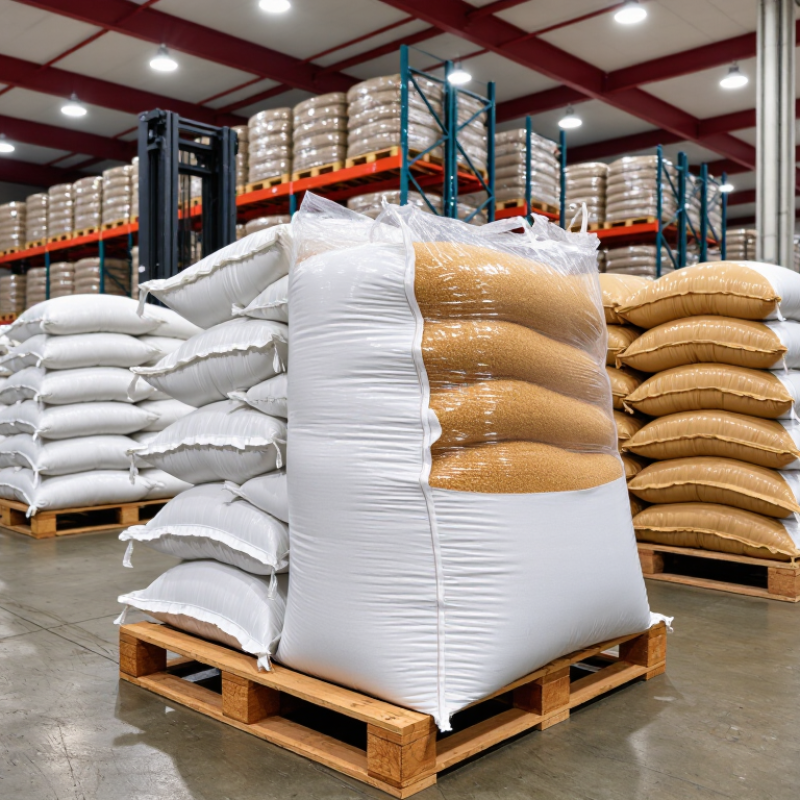
Grain FIBC Basics: 500–2,000 kg SWL and 5:1 Safety Factors
For global grain buyers, FIBC selection begins with two figures: SWL and safety factor. Common grain bags support 500–2,000 kg SWL, depending on fabric, construction, filling method, and discharge design. SWL means the maximum recommended working load under stated conditions. It is not a target to exceed.
A 5:1 safety factor means a bag rated for 1,000 kg should have a minimum tested breaking strength of 5,000 kg under defined conditions. This margin covers handling stress, but it does not correct poor lifting practice. Forklift contact, uneven filling, wet grain, sharp pallets, and repeated reuse can reduce real performance. Always inspect lifting loops and seams before loading.
Details matter. A reliable supplier should provide test records, material specifications, stitching information, and traceable production details. Ask whether the bag is designed for food-contact use, outdoor exposure, or single-trip handling. Moisture can collect inside a bag during temperature changes, even when the outer fabric looks dry. That risk deserves attention.
In warehouse trials, operators should lift a filled bag slowly and keep personnel away from suspended loads. This sounds obvious. It is often missed. Regional transport and food-packaging requirements may also differ, so buyers should verify applicable rules before ordering. A clean specification helps, but field conditions still need honest review.
Food-Grade PP Selection: 120–200 g/m² Fabric and Liner Choices
China Best Grain FIBC Bags for Global Buyers?
Global grain trade demands clean, stable, and traceable bulk packaging. The FAO Food Outlook 2024 estimated global cereal production near 2.85 billion tonnes. That volume increases pressure on bag performance, hygiene, and loading efficiency. For food-grade FIBCs, 120–200 g/m² polypropylene fabric offers a practical range. Lower weights can reduce cost and handling effort. Higher weights provide stronger resistance against abrasion, stacking pressure, and rough warehouse floors.
Fabric weight alone does not confirm safety. Food-contact declarations, migration testing, odor control, and clean manufacturing records matter more. ISO 21898 provides relevant requirements for flexible intermediate bulk containers, including construction and testing considerations. Buyers should also request batch identification, test certificates, and documented cleaning controls. Small details matter. A dusty filling spout can undermine an otherwise suitable bag.
Liner selection depends on moisture, oil, and contamination risks. A loose polyethylene liner supports basic grain protection and easier discharge. A form-fit liner can reduce folds, trapped residues, and product loss during filling. For sensitive grains, buyers may consider thicker liner films, but excessive thickness can slow discharge and increase waste. The 200 g/m² fabric may feel safer, yet that assumption is incomplete. In practical sourcing, the best specification balances load size, transport distance, storage duration, and filling equipment. One weakness remains: no fabric grade compensates for poor sealing or careless warehouse handling.
China Best Grain FIBC Bags for Global Buyers? - Food-Grade PP Selection: 120–200 g/m² Fabric and Liner Choices
| Selection Level | PP Fabric Weight | Recommended Liner | Typical Grain Applications | Protection Level | Typical Bag Construction | Purchasing Considerations |
| Economical | 120 g/m² | Food-contact polyethylene liner when contamination or fine-particle control is required | Dry wheat, corn, rice, barley and other free-flowing grains under controlled handling conditions | Basic protection against dust and handling abrasion; limited moisture protection without a liner | Coated or uncoated woven PP body, standard four-loop lifting design, top filling and bottom discharge options | Confirm safe working load, safety factor, seam strength and filling density; suitable mainly for moderate transport cycles |
| Balanced | 140 g/m² | Loose polyethylene liner or sewn-in liner for improved cleanliness and product separation | Rice, wheat, pulses and seed products requiring routine export handling | Improved durability and cleanliness for normal warehouse and container logistics | Woven PP body with reinforced lifting loops, dust-proof seams where specified, and optional sift-proof construction | A practical general-purpose choice when cost, handling strength and product hygiene must be balanced |
| Export Standard | 160 g/m² | Form-fit polyethylene liner, preferably with sealed or well-controlled filling and discharge interfaces | Long-distance shipment of rice, maize, wheat, soybeans and food-grade agricultural commodities | Good resistance to abrasion, repeated handling and ordinary supply-chain movement | Stabilized woven PP fabric, reinforced seams, optional coated fabric, and filling/discharge spouts matched to the liner | Often selected for export programs; validate pallet pattern, container utilization and load-testing results |
| Heavy-Duty | 180 g/m² | Sewn-in polyethylene liner or form-fit liner for higher cleanliness and moisture separation | Dense grains, repeated lifting, rough warehouse conditions and extended distribution routes | Higher abrasion and handling margin than lighter fabric options; not a substitute for waterproof packaging | Heavy woven PP body, reinforced corner or cross-corner loops, stronger seams and optional anti-static configuration | Specify the required safe working load and safety factor independently of fabric weight; request a test certificate |
| Maximum Fabric Margin | 200 g/m² | Heavy-duty form-fit liner; barrier or foil-laminate structures only when the product and storage conditions justify them | High-density grains, demanding export routes, frequent handling or applications requiring additional fabric robustness | Highest abrasion margin among the listed fabric options, while humidity control still depends on the liner and storage environment | Heavy woven PP, reinforced seams and loops, optional coated outer surface, and customized filling/discharge assemblies | May increase tare weight and cost; choose it when handling conditions justify the added material rather than using fabric weight alone |
Technical notes: Food-grade status applies to the complete product-contact system, including woven PP, coatings, liners, sewing thread and printing inks, and should be supported by applicable compliance documentation for the destination market. Fabric weight alone does not determine safe working load. Confirm bag dimensions, filling density, lifting-loop design, seam strength, safety factor, liner fit, moisture requirements and transport testing before purchase.
Global Grain Shipping: Container Payloads, Pallets, and Moisture Risk
China Best Grain FIBC Bags for Global Buyers?
Global grain shipping begins with realistic container mathematics. ISO 668 sets a 20-foot container’s maximum gross mass at 30,480 kilograms. After tare weight, practical cargo capacity often falls near 26–28 tonnes. The World Shipping Council also stresses accurate verified gross mass declarations. A FIBC rated for 1,000 kilograms may still exceed safe loading limits when pallets, liners, and moisture are added. Small errors become expensive quickly.
Pallet design changes the payload. Standard pallets can improve forklift handling, but they consume valuable floor space. A container may hold more unpalletized bags, yet unloading becomes slower and less controlled. For export grain, buyers should confirm bag size, safe working load, stacking height, and lifting-loop strength. The USDA Grain Inspection Handbook emphasizes consistent sampling and moisture measurement. Testing should occur before filling, after loading, and during destination checks. One inspection is not enough.
Moisture is the quiet risk. FAO grain-storage guidance links high moisture and warm conditions with mold, insects, and quality loss. For many maize supply chains, operators target roughly 13% moisture for safer storage, but the correct level depends on crop, duration, and climate. Use food-grade liners only when condensation risk is assessed. Desiccants may help, but they cannot rescue wet grain. A dry bag is not always a dry shipment. Condensation can form under a cold container roof, especially after ocean temperature changes. I would not promise zero moisture risk; better loading records and ventilation decisions are more credible.
Supplier Due Diligence: COAs, Batch Tests, and Traceable Production Records
China Best Grain FIBC Bags for Global Buyers?
Supplier Due Diligence: COAs, Batch Tests, and Traceable Production Records
A reliable grain FIBC supplier should provide a Certificate of Analysis for each production lot. Check the lot number, test date, laboratory, test methods, and acceptance limits. The COA should match the bags shipped, not a different sample. Ask for results covering fabric strength, seam performance, moisture, and food-contact suitability where applicable.
Paperwork alone is not enough. Request batch test reports from recent shipments, including sample quantities and measured values. An independent laboratory can verify critical results before loading. Keep sealed samples from every batch. This creates evidence if a bag later fails during filling, storage, or transport. Small details matter.
Traceable production records should connect raw material receipts to weaving, cutting, sewing, inspection, and final release. A useful record identifies operators, machine lines, inspection dates, and corrective actions. Visit the factory when possible. Review storage areas, because damp resin or dusty sewing rooms can undermine good procedures. Some suppliers present excellent documents but weak floor controls. That gap deserves attention. I have learned that a fast answer is not always a reliable answer. Buyers should compare records with physical samples, photographs, and shipment details before approving repeat orders.
China Best Grain FIBC Bags for Global Buyers? — Supplier Due Diligence
A practical evidence checklist for reviewing COAs, batch testing, and traceable FIBC production records before purchase.
The values represent checklist items to verify, not company performance claims or market-share statistics. Buyers should confirm the applicable specification, test method, batch number, and approval signature for each shipment.