

How to Choose the Best Clay Litter for Your Cat?
Choosing the right Clay Litter is about more than stopping odors. Your cat must also feel comfortable using it. A fine-grained litter may feel softer beneath sensitive paws, while larger granules can track less across the kitchen floor. Clumping strength, dust, scent, and ease of scooping all matter. So does your cat’s response. A tidy box means little if your cat avoids it.
Cat behaviorist Dr. Mikel Delgado studies how cats interact with their environments. A practical takeaway from her work, paraphrased rather than quoted, is: “The best litter is one your cat comfortably and consistently uses.” That is a useful starting point, not a complete buying rule. Watch for changes in box habits, and introduce a new litter gradually. If avoidance continues, consider health concerns and consult a veterinarian.
This guide compares common clay formulas, including clumping and non-clumping options. It looks at dust control, odor management, tracking, and cleanup. You’ll also find ways to weigh package claims against what happens at home: paws leaving granules by the mat, a scoop breaking through a weak clump, or a fragrance lingering after cleaning. No formula wins every category. A little trial and observation may be needed. Choose with your cat’s comfort in mind, then reassess honestly.
Understand the Main Types of Clay Cat Litter
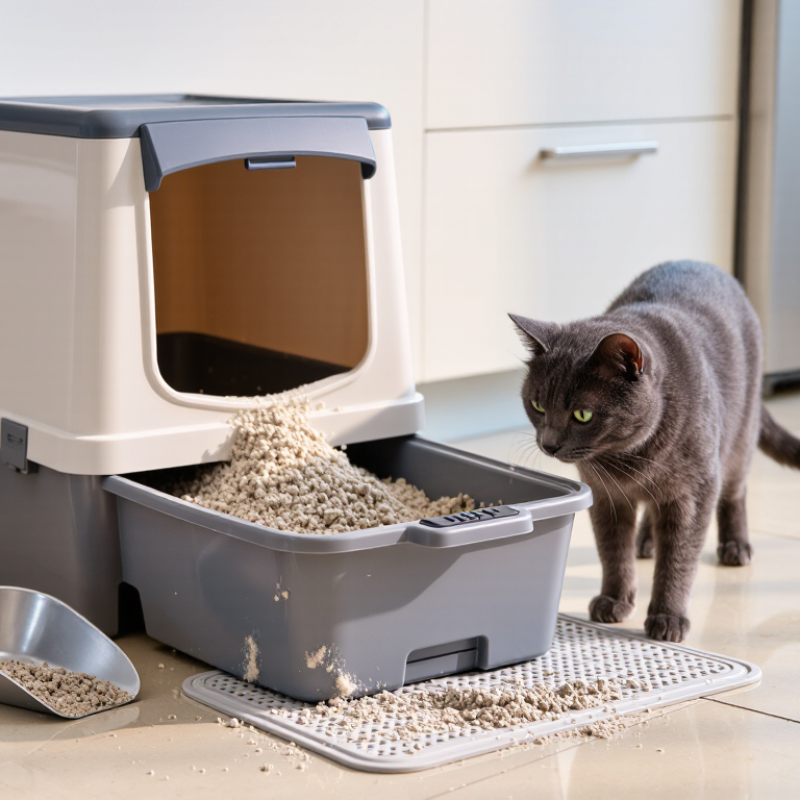
Clay litter is commonly sold in clumping and non-clumping forms. Clumping varieties often use sodium bentonite, which absorbs urine and forms firm, scoopable lumps. This can make daily cleaning easier and helps you remove wet spots without replacing all the litter. The texture may feel gritty under a cat’s paws, though, and some formulas create noticeable dust.
Non-clumping clay absorbs moisture but usually does not form scoopable clumps. It can suit cats who dislike firmer textures, but wet litter stays in the tray until you change it. That means more frequent full changes may be needed to control odor. Lightweight clay blends are another option; they are easier to carry, but can scatter more easily around the box. No type works for every cat. I’ve found that small differences in texture can matter more than expected.
Tips: Start with an unscented, low-dust option when possible. Keep the tray in a ventilated spot, and watch for sneezing, paw irritation, or refusal to use it. Change types gradually by mixing a little new litter into the old. Cats can be particular.
How to Choose the Best Clay Litter for Your Cat? - Understand the Main Types of Clay Cat Litter
| Type or Feature | Typical Composition | How It Works | Advantages | Things to Consider | May Suit |
|---|---|---|---|---|---|
| Clumping clay litter | Usually bentonite clay, often sodium bentonite. | Forms clumps around liquid waste, which can be scooped out while the remaining litter stays in the box. | Convenient daily scooping; waste is easy to remove; the litter box may need less frequent full replacement when maintained properly. | Can be dusty or track outside the box, depending on the product. Clumps and used litter must be disposed of according to local waste rules; do not flush unless the product and local plumbing guidance explicitly allow it. | Households that prefer removing urine clumps each day and topping up the litter as needed. |
| Non-clumping clay litter | Often made with absorbent clay such as calcium bentonite, though formulations vary. | Absorbs liquid into the litter rather than forming firm, scoopable clumps. Solid waste is removed, and the litter is replaced regularly. | Often straightforward to use and may cost less per bag than some clumping options. | Urine is not removed as a separate clump, so the litter generally needs more frequent full changes to control odor and maintain cleanliness. | Owners who prefer a non-clumping litter and are comfortable replacing it on a regular schedule. |
| Lightweight clay litter | Clay-based litter made lighter by using less dense material or adding lightweight components; composition varies. | May be clumping or non-clumping. Its lighter weight changes how easy the bag is to carry, not necessarily how the litter performs. | Easier to lift, pour, and store than many standard-weight bags. | Some formulas may scatter or track more because the particles are lighter. Check the product label for dust and clumping details. | People who find standard litter bags difficult to carry or handle. |
| Unscented clay litter | Clumping or non-clumping clay without added fragrance. | Controls odor through absorption and, in some formulas, other odor-control ingredients rather than perfume. | A useful starting point for cats or people sensitive to added scents. | Unscented does not mean odor-free; regular scooping and cleaning are still important. | Most households, especially when a cat avoids strongly scented litter. |
| Scented clay litter | Clumping or non-clumping clay with added fragrance. | Uses fragrance to mask or reduce the perception of litter-box odors. | Some owners prefer its added scent. | Fragrance may bother some cats or people, and it does not replace routine cleaning. If a cat avoids the box, consider trying an unscented option. | Households that have tried it and find both the cat and people tolerate the fragrance. |
Choosing tip: Start with your cat’s preferences, then compare dust, tracking, fragrance, and cleaning routine. “Clumping” and “non-clumping” describe how the litter handles liquid; scent and weight are separate product features. Clay formulas vary, so check the package for specific ingredients and care instructions.