How to Choose the Best Wood Cutting Board Set?
Choosing the right Wood Cutting Board Set is not only about appearance or price. It affects daily preparation, knife performance, cleaning habits, and kitchen safety. A well-chosen set may include different board sizes for vegetables, bread, meat, or quick snack preparation. That flexibility matters when counter space is limited.
Look closely at the wood, construction, and finish. Hardwoods such as maple, walnut, and acacia are often valued for durability, though each has different grain patterns and maintenance needs. A thick board usually feels steadier under a chef’s knife. Deep juice grooves can help contain moisture from tomatoes or roasted meat. Non-slip feet may also improve control, especially on smooth stone counters. However, these features are not automatically better. They can make washing and storage less convenient.
Experience teaches that care often matters more than the original price. Wood boards should usually be hand-washed, dried upright, and treated with food-grade mineral oil when the surface looks pale or rough. Never assume every finish is suitable for food contact; check the manufacturer’s guidance. Some boards arrive beautifully polished but show knife marks quickly. That is normal, not necessarily a defect. I have also found that oversized boards can become frustrating when they do not fit the sink. The best choice depends on your cooking routines, available space, and willingness to maintain the surface. This guide examines those practical details, helping you compare materials, sizes, craftsmanship, hygiene considerations, and long-term value with a more realistic eye.
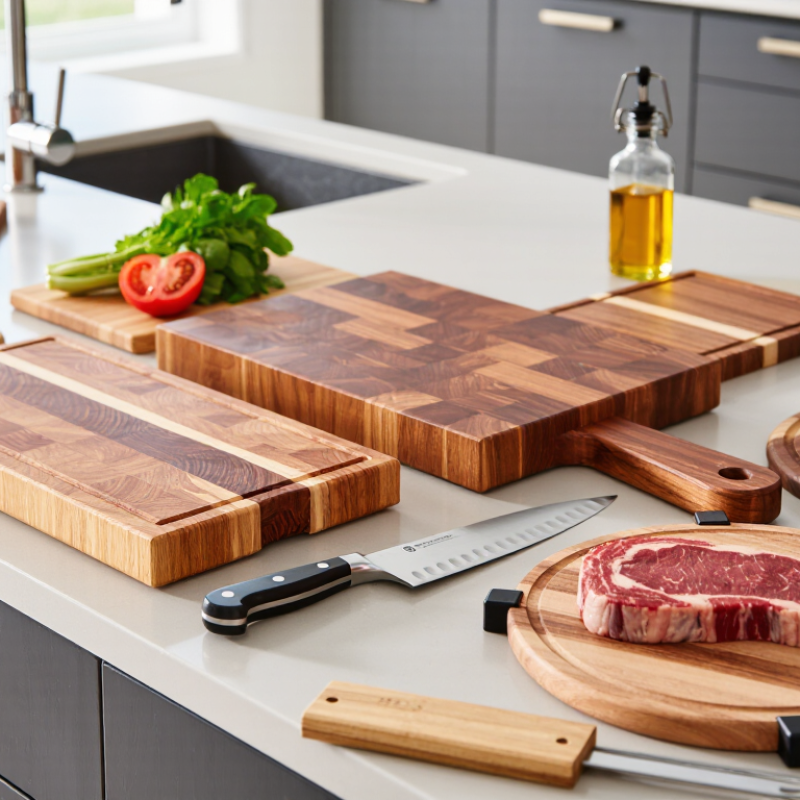
Classify Board Construction: Compare End-, Edge-, and Face-Grain Designs
Choosing the best wood cutting board set starts with understanding grain direction. Each construction changes durability, knife feel, cleaning needs, and price.
End-grain boards place the wood fibers vertically, like a bundle of short straws. Your knife enters between the fibers instead of cutting directly across them. This design can reduce visible scoring and feels gentle during chopping. It is usually thick and heavy, though. A large end-grain board may need both hands to move safely. Keep it dry after washing and apply food-safe mineral oil when the surface looks pale. “Self-healing” is only a partial benefit; deep cuts still remain.
Edge-grain boards arrange long wood strips side by side. They offer a strong balance between stability, weight, and cost. For daily vegetables, herbs, and boneless meat, this design is often practical. Look for a flat surface, tight joints, and enough thickness to resist warping. My own mistake was choosing a board that looked sturdy but slid across the counter. Rubber feet or a damp towel can improve control.
Face-grain boards show the broad, attractive face of the wood. They are often lighter and more affordable, making them useful for serving bread, fruit, or light prep. However, repeated heavy chopping may mark the surface faster. Moisture matters. Never leave one soaking in a sink. A thoughtful set may combine one thick edge- or end-grain board for preparation with a smaller face-grain board for serving. Size, storage space, and maintenance habits should guide the final choice.
How to Choose the Best Wood Cutting Board Set?
Comparing end-, edge-, and face-grain construction across the characteristics that matter most in daily kitchen use.
End-Grain The exposed fiber ends absorb knife impact, making this design highly knife-friendly and relatively resistant to visible cuts. It requires more careful drying and maintenance.
Edge-Grain A balanced construction that combines good durability, stability, and knife comfort, often making it a practical everyday choice.
Face-Grain Usually lighter and more affordable, but its broad surface shows knife marks sooner and is better suited to lighter preparation tasks.
Scores use a comparative 1–5 performance scale based on the typical behavior of each grain orientation; wood species, thickness, finish, and maintenance can change results.
Set Size and Thickness: Evaluate Stability Across 20–40 mm Boards
Choosing a wood cutting board set starts with thickness, not appearance. For everyday prep, 20–25 mm boards are easier to lift, wash, and store. However, they can shift when chopping hard squash or dense roots. A 30–40 mm board provides more mass and resists rocking on a flat counter.
The numbers make this practical. A 30 × 40 cm board made from wood near 700 kg/m³ weighs about 1.7 kg at 20 mm thickness. At 40 mm, it approaches 3.4 kg. These density and volume relationships follow data in the USDA Forest Products Laboratory’s Wood Handbook, FPL-GTR-282 (2021). More weight usually means better stability, but it also increases handling effort. Too heavy can become inconvenient.
A mixed set can work well: choose a 30–40 mm main board for chopping, then add thinner 20–25 mm boards for fruit, bread, or quick tasks. USDA FSIS guidance recommends maintaining clean, smooth cutting surfaces and replacing boards with deep grooves that are difficult to clean. Thickness does not prevent contamination by itself. Grain direction, proper drying, and stable construction matter too. I would not assume the thickest board is automatically best. A poorly dried 40 mm board may warp, while a carefully made 25 mm board can feel steadier. Measure the counter space, check the board’s weight, and test whether it remains firm under repeated knife pressure. Stability is felt in the first few cuts.
How to Choose the Best Wood Cutting Board Set? - Set Size and Thickness: Evaluate Stability Across 20–40 mm Boards
Comparison of Practical Wood Cutting Board Set Configurations | Set Size | Board Dimensions
(Length × Width) | Thickness | Approx. Weight
Per Board | Approx. Total Wood Weight | Stability on the Countertop | Recommended Use |
| 2-piece set | 30 × 20 cm
(11.8 × 7.9 in) | 20 mm
(0.8 in) | 0.84 kg
(1.85 lb) | 1.68 kg
(3.70 lb) | Moderate | Light preparation, fruit, bread, and occasional small chopping tasks. |
| 2-piece set | 35 × 25 cm
(13.8 × 9.8 in) | 25 mm
(1.0 in) | 1.53 kg
(3.38 lb) | 3.06 kg
(6.75 lb) | Good | A balanced everyday option for vegetables, herbs, and boneless meat. |
| 3-piece set | 35 × 25 cm
(13.8 × 9.8 in) | 30 mm
(1.2 in) | 1.84 kg
(4.06 lb) | 5.51 kg
(12.15 lb) | Very good | Frequent meal preparation requiring a more stable cutting surface. |
| 3-piece set | 40 × 30 cm
(15.7 × 11.8 in) | 30 mm
(1.2 in) | 2.52 kg
(5.56 lb) | 7.56 kg
(16.67 lb) | Very good | Large-volume chopping, meal preparation, and general kitchen use. |
| 4-piece set | 35 × 25 cm
(13.8 × 9.8 in) | 35 mm
(1.4 in) | 2.14 kg
(4.73 lb) | 8.58 kg
(18.92 lb) | High | Heavy chopping and users who prefer a solid, substantial board. |
| 4-piece set | 40 × 30 cm
(15.7 × 11.8 in) | 35 mm
(1.4 in) | 2.94 kg
(6.48 lb) | 11.76 kg
(25.93 lb) | High | Large ingredients, frequent cooking, and demanding preparation work. |
| 4-piece set | 40 × 30 cm
(15.7 × 11.8 in) | 40 mm
(1.6 in) | 3.36 kg
(7.41 lb) | 13.44 kg
(29.63 lb) | Very high | Maximum countertop solidity, intensive chopping, and professional-style preparation. |
Data notes: Approximate weights are calculated from board volume using a representative dry hardwood density of 700 kg/m³. Actual weight varies with wood species, moisture content, edge-grain or end-grain construction, handles, juice grooves, and non-slip feet. Thickness generally increases mass and resistance to movement, but countertop grip, a flat underside, and proper maintenance also affect stability.
Check Food-Safety Compliance with FDA Food Code and NSF/ANSI 2
When choosing a wood cutting board set, food safety should guide the decision. Start by checking how the wood is described. The FDA Food Code permits hard maple or similarly hard, close-grained wood for certain cutting boards and food-contact uses. However, local health departments may apply additional requirements. Always verify the current rules for your kitchen.
Look for clear supplier documentation, not vague claims. NSF/ANSI 2 addresses food equipment design, materials, construction, and cleanability. A board should be smooth, durable, free from deep cracks, and easy to wash and sanitize.
Check whether the exact product or model is covered by an NSF/ANSI 2 certification, rather than assuming every wooden board qualifies. That distinction matters.
Inspect the set in person when possible. Run your fingers across the surface. It should not feel rough or splintered. Examine the edges, feet, handles, and any juice groove, where food residue can collect. Separate boards by task, such as raw meat, produce, and ready-to-eat foods. Color coding helps, but it is not a substitute for cleaning.
Wood also needs careful maintenance. Follow the manufacturer’s washing instructions, avoid leaving boards submerged, and let them dry upright. Replace boards with persistent odors, warping, or deep knife marks.
I would not treat a compliance label as a magic shield. Even a well-made board can become unsafe when neglected. That is the part many buyers overlook.
Compare Wood Species Using Janka Hardness Ratings from 1,000–1,500 lbf
When choosing a wood cutting board set, start with Janka hardness ratings between 1,000 and 1,500 lbf. This test measures the force needed to press a steel ball into wood. It offers a useful comparison, but it is not a complete durability score. Moisture, grain direction, board thickness, and maintenance also affect performance.
Walnut often sits near 1,000 lbf, while teak commonly reaches about 1,070 lbf. Beech and ash usually fall near 1,300 lbf, and hard maple can approach 1,450 lbf. These figures are approximate because growing conditions and testing methods can change results. Softer woods may feel gentler under a knife. Harder woods can resist dents better, but they may feel less forgiving during long chopping sessions. That trade-off matters.
In a three-piece set, pair a medium-hard board for vegetables with a thicker board for meat preparation. Look for stable grain, smooth edges, and enough weight to stay still on a damp towel. End-grain construction can absorb repeated knife contact, though it often costs more and needs careful drying. I have found that even a hard board can warp when left beside a sink. Keep it simple. Wash it promptly, dry it upright, and apply food-safe board oil when the surface looks pale. A Janka number helps narrow the choice, but your cutting habits should make the final decision.