

How to Choose Custom Clear Umbrellas?
Choosing Custom Clear Umbrellas starts with a simple question: where will people use them? A compact canopy may suit crowded streets, while a larger one offers more coverage at outdoor events. The clear panel keeps faces visible and lets printed colors stand out. But clarity alone does not guarantee a good umbrella. Check the frame, joints, handle grip, canopy seams, and opening action. Test a sample in your hand, not just in a product photo.
For this guide, the illustrative product specialist Elena Brooks offers a practical rule: “Choose for the weather, the user, and the message—not just the clear canopy.” Treat that as a useful design principle, not a verified quotation from an outside source. Ask suppliers which canopy material they use, how printing affects transparency, and whether the frame is tested for repeated opening. Small details matter. A slick handle can feel awkward when wet. Dense artwork may also obscure the view.
The right choice depends on use, budget, branding, and order quantity. Request a physical sample when possible, and compare it under daylight and indoor lighting. Confirm dimensions, color placement, packaging, and production timing in writing. These checks cannot promise a long service life; wind, handling, and storage all play a part. A clear umbrella can look polished on screen and still disappoint in person. That gap is worth checking before placing a custom order.
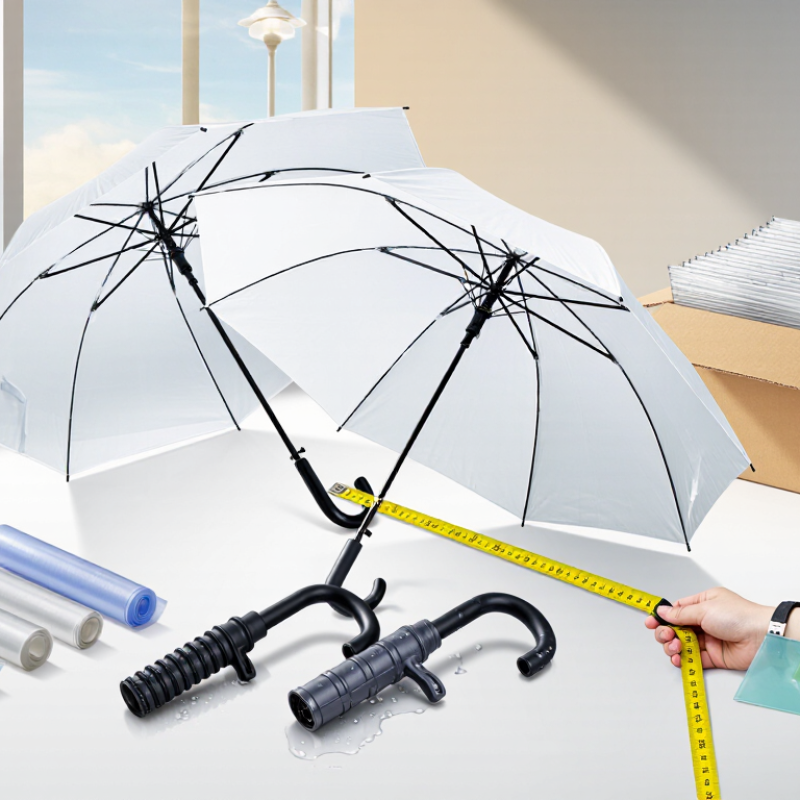
Understand the Materials and Design of Custom Clear Umbrellas
A clear umbrella is only as useful as its materials. Many canopies use PVC or POE film, but the feel and performance can differ. PVC often feels firmer, while POE can feel lighter and more flexible. Ask for the exact material and thickness rather than relying on “clear” as a specification. Transparency also varies: some film looks crisp indoors but shows glare or water spots outdoors. Check a sample in daylight. Small details matter.
The frame shapes how the umbrella handles rain and wind. Fiberglass ribs are flexible, while metal components can add stiffness and weight. Neither choice alone guarantees durability; joints, rib count, and canopy attachment matter too. Open and close a sample several times. Notice whether the ribs stay aligned and the slider moves smoothly. A deeper dome can help keep rain away from shoulders, but may catch more wind. Handle shape and length affect comfort, especially when carried for a while. For custom designs, keep printed artwork away from seams and folded areas, where it may distort. I’ve found that a neat mock-up can still feel awkward in use, so test the finished layout before ordering a full batch.
How to Choose Custom Clear Umbrellas? - Understand the Materials and Design of Custom Clear Umbrellas
| Design or Material | Common Options | Practical Characteristics | What to Check When Customizing |
|---|---|---|---|
| Clear canopy film | PVC or POE film | Both can provide a transparent canopy. PVC is commonly used for clear rainwear and umbrellas; POE is another flexible film option. Transparency, flexibility, thickness, and feel vary by specification. | Request the exact material, film thickness, clarity sample, and flexibility information. Do not assume clear film provides UV protection. |
| Canopy construction | Panel canopy with stitched or welded joins | The number and shape of panels affect the canopy profile and available decoration area. Construction methods depend on the film and umbrella design. | Confirm the panel count, finished canopy shape, seam construction, and how the design will look across panel joins. |
| Frame and ribs | Fiberglass, steel, or aluminum components | Fiberglass ribs can flex and do not rust. Steel components are strong but may corrode if protective coatings are damaged. Aluminum is lightweight and corrosion-resistant but can bend under load. | Ask which parts use each material, how joints are reinforced, and whether metal components have a protective finish. |
| Opening mechanism | Manual or automatic opening | Manual models open by hand. Automatic models use a button-operated spring mechanism; the exact operation and closing method vary by model. | Check whether the umbrella opens, closes, or both at the push of a button, and test the mechanism on a sample. |
| Canopy shape and coverage | Dome, bell, or standard canopy | A deeper dome or bell shape can provide more side coverage than a shallower canopy. Actual coverage depends on the canopy dimensions and how the umbrella is held. | Compare canopy diameter and depth, overall length, and folded length. Confirm whether measurements refer to the open canopy or the frame. |
| Handle and tip | Plastic, wood, or coated handle; matching or contrasting tip | Handle shape and surface affect grip and appearance. The tip covers the canopy’s top attachment point and can be coordinated with other components. | Specify handle material, color, shape, finish, and tip style. Check that the handle is comfortable to hold. |
| Custom decoration | Printed panels, logos, or colored trim | Printing on transparent film can appear different from printing on opaque fabric. Artwork placement, ink opacity, and viewing angle affect visibility. | Request a print proof on the chosen clear material. Confirm print area, color matching, ink suitability, and whether printing is inside or outside the canopy. |
| Wind and rain use | Frame design, rib arrangement, and canopy fit | Performance depends on the complete umbrella construction, not a single material. No umbrella should be treated as storm-proof unless supported by relevant testing and specifications. | Ask for documented testing details if wind performance is important. Check frame stability, rib connections, and canopy attachment on a finished sample. |
| Care and storage | Drying and protective storage | Allow a wet umbrella to dry open before storing it. Follow care guidance for the selected canopy film and avoid prolonged exposure to heat or sharp objects. | Include care instructions with the product and confirm whether a sleeve or protective cover is available. |