

Blog
Blog
Blog
10 Tips for Buying Eyelash Extension Kits Wholesale
Buying wholesale Eyelash Extension Kits can lower costs, but a low unit price is only one part of the decision. The right kit should suit your artists’ techniques, your clients’ needs, and the pace of your salon. Before placing a large order, inspect sample lashes, check the adhesive’s stated storage conditions, and review the supplier’s batch and product information. Small details matter. A tweezer that feels awkward after one set may slow an entire appointment day.
This guide shares 10 practical tips for comparing Eyelash Extension Kits wholesale, from material consistency and kit contents to minimum order quantities, shipping, and supplier communication. Lash educator and salon owner Elena Morris puts the principle plainly: “A wholesale deal is only valuable when every kit performs consistently.” Use that as a reminder to compare more than catalog photos. Ask for clear specifications, confirm what is included, and test products under your normal working conditions. A neat sample is encouraging, but it cannot answer every question.
Some checks take time. That is useful, not wasteful. Keep notes on curl, length, packaging, and how easily staff can find each item during a service. If a supplier’s answers are vague, pause before committing. No checklist can remove every risk, and even careful buyers may need to revise their preferred product mix. The goal is a dependable supply—not the biggest order or the lowest price.
Understanding What an Eyelash Extension Kit Includes
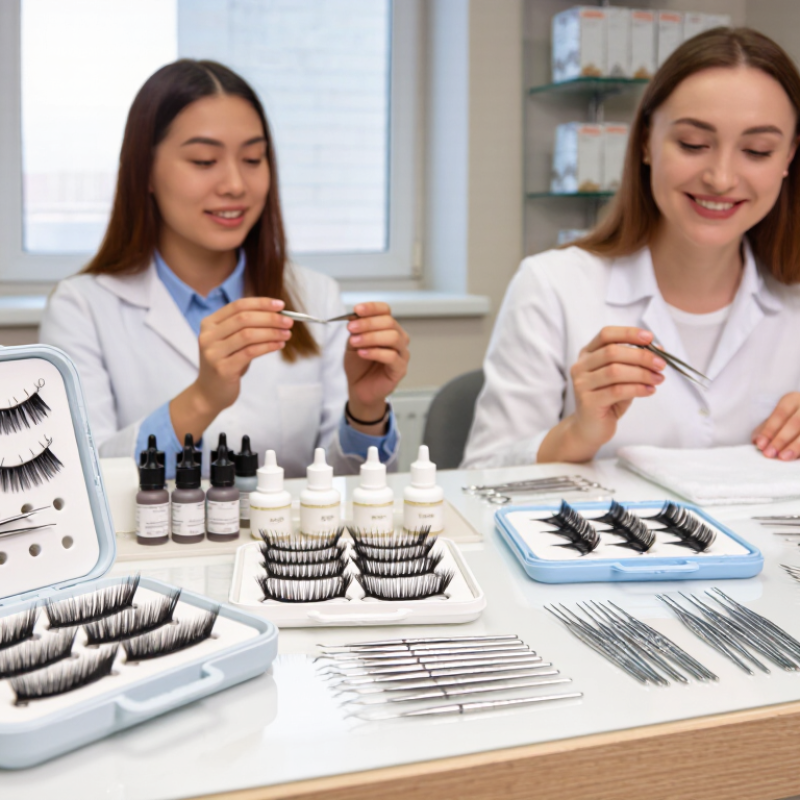
An eyelash extension kit is a collection of tools and supplies for applying individual extensions, but the exact contents vary. Most include lash trays with different lengths, curls, and thicknesses, plus tweezers for isolating natural lashes and placing extensions. Look for under-eye pads, medical-grade tape intended for lash work, spoolie brushes, and a cleansing product. Some kits also contain adhesive, remover, primer, or a practice mannequin.
Small parts matter.
Do not assume a larger kit is automatically better. Check the itemized contents, quantities, and whether liquids arrive sealed with clear ingredient and storage information. Adhesive has a limited usable life, so review its stated shelf life and storage instructions before ordering wholesale.
Ask for a sample kit when possible; inspect the lash fibers, tweezer alignment, and packaging rather than relying on product photos. It is easy to overlook replacement supplies when comparing prices, and that can make a low-cost kit less practical.
For professional use, follow the supplied directions and keep products away from the eyes themselves. A kit may still need extra tools.
That detail deserves a second look.
Defining Your Business Needs and Product Requirements
Before comparing wholesale kits, describe the work your business actually performs. Are most appointments classic sets, light volume, or mixed styling? Start with your client. Record common eye shapes, preferred looks, and appointment times, then use those notes to set a realistic product list. A kit with many curl types can look economical, yet unused trays tie up cash and shelf space. Keep it measurable. Estimate monthly service volume and decide how many trays, tweezers, brushes, and practice materials you can use before reordering.
Write down technical requirements before requesting quotes: fiber feel, curl options, length range, tray layout, and clear labeling. Check whether adhesive is included, and ask for its storage guidance and stated usable period after opening. Adhesive performance can shift with room temperature and humidity, so match instructions to the conditions in your workspace. If you are testing a new style, order a small evaluation quantity when possible; photos rarely show how easily fibers separate or how consistently strips release. Ask suppliers for product specifications, batch consistency information, and replacement terms in writing. You may not predict every client preference, and early estimates are often off, but a simple checklist makes comparisons more honest.
| Tip | Business need to define | Product requirements to specify | What to check before placing a wholesale order |
|---|---|---|---|
| 1. Identify your target customer | Decide whether the kits are for trained lash professionals, students, or retail customers. Their skill levels and intended use differ. | Set the intended user, use case, and whether the kit is for salon services, education, or at-home use. | Review every item and instruction for suitability for the intended user. Avoid presenting a professional-use kit as suitable for untrained users unless its design and labeling support that use. |
| 2. Define the kit contents | Determine which items customers need for the service and which can be purchased separately. | List each component, such as lash extensions, tweezers, under-eye pads, tape, brushes, cleanser, or adhesive, and specify quantities. | Request a written packing list and confirm that sample kits match the proposed order contents. Check whether consumables and tools are included or sold separately. |
| 3. Specify lash styles and dimensions | Choose an assortment that fits the techniques and looks your customers request. | State the preferred curl, length range, thickness, fiber type, tray format, and single-length or mixed-length configuration. | Ask for product specifications and samples. Compare labels and physical samples; do not assume curl or length descriptions are interchangeable across suppliers. |
| 4. Set adhesive requirements | Decide whether adhesive belongs in the kit and identify the users and markets for which it is intended. | Specify ingredient information, directions, storage conditions, package size, and relevant safety documentation, such as a Safety Data Sheet where applicable. | Check the product label, documentation, stated shelf life, and market-specific rules. Adhesives may contain ingredients that can cause irritation or allergic reactions; follow the supplier’s directions and applicable professional guidance. |
| 5. Check labeling and regulatory needs | Identify the countries or regions where you will sell or use the kits. | Define required languages, ingredient and warning information, traceability details, and any market-specific labeling or product documentation. | Verify requirements with the relevant authorities or a qualified compliance professional. Requirements vary by jurisdiction and by product type; do not rely on a generic label for every market. |
| 6. Evaluate packaging and storage | Choose packaging that protects components during shipping and fits your sales channel. | Specify sealed packaging where appropriate, component organization, protection from moisture or contamination, and storage instructions. | Inspect samples for damage, secure closures, clear identification, and usable storage directions. Confirm any stated shelf life and storage conditions for products such as adhesive. |
| 7. Confirm quality and consistency | Set an acceptable level of product variation and a process for handling defects. | Write down measurable specifications for lash dimensions, tray quantities, tool function, packaging, and other critical components. | Compare samples with the written specifications. Ask how production batches are checked, how lot information is recorded, and how shortages or defects are handled. |
| 8. Calculate total landed cost | Set a target cost that accounts for more than the quoted unit price. | Estimate product cost, packaging, freight, insurance, duties, taxes, and any inspection or handling charges that apply. | Request a written quotation that identifies the pricing basis, currency, order quantity, shipping terms, and any additional charges. Confirm import costs with your carrier or customs adviser. |
| 9. Plan order quantity and lead time | Match the order size to expected demand, cash flow, storage capacity, and seasonal sales. | Record minimum order quantity, production time, shipping estimate, reorder point, and acceptable delivery window. | Ask whether mixed styles or components can be ordered together and whether repeat orders have the same minimums and lead times. Build time for sampling and inspection into the schedule. |
| 10. Test samples and serviceability | Make sure the kit is practical for the people who will use it and support the service you plan to offer. | Define a sample-testing checklist for component completeness, ease of use, packaging, instructions, and consistency with the approved specifications. | Evaluate samples before committing to volume. Follow product directions and appropriate hygiene practices; use single-use items only once and clean or disinfect reusable tools according to their instructions. |
Evaluating Wholesale Suppliers and Product Quality
A low unit price means little if lash trays arrive with uneven curls, loose fibers, or inconsistent lengths. Grand View Research’s 2023 eyelash-extension market analysis estimated a 6.2% compound annual growth rate for 2023–2030. That growth makes supplier claims worth checking, not accepting at face value. Ask for a current product specification sheet, batch traceability, and written return terms before placing a large order.
Inspect samples under bright, neutral light. Compare several trays for curl shape, band thickness, fiber alignment, and labeling. Check that adhesive documentation includes a Safety Data Sheet and clearly identifies the product and batch. ISO 22716 offers cosmetics good-manufacturing-practice guidance; ask suppliers how their quality controls align with it. Paperwork helps, but it cannot replace a physical inspection. Small flaws matter.
A practical test is to order samples from more than one production batch, then record defects and delivery times. Ask who handles quality complaints and whether replacement stock comes from the same batch. A polished catalog is not proof of consistent production. One limitation: a few samples cannot predict every future shipment. Keep notes, photos, and purchase records, and reassess suppliers when packaging, product feel, or performance changes.
10 Tips for Buying Eyelash Extension Kits Wholesale: Check Fiber Diameter
Commonly marketed nominal diameters for individual eyelash extensions, in millimeters.
Diameter options vary by supplier and product line. Before placing a wholesale order, request samples and verify the stated diameter and consistency against the supplier’s specifications.
Comparing Prices, Minimum Orders, and Shipping Terms
When comparing eyelash extension kits wholesale, calculate landed cost, not unit price. Add freight, handling fees, taxes, and any charges for split shipments. A kit priced lower may cost more once it reaches your studio. Request quotes for the same quantity and delivery destination, then compare the totals in writing. Tip: Compare like with like. Small details matter.
Minimum order quantity affects both cash flow and stock risk. Ask whether the supplier permits mixed kit types, a trial order, or repeat orders at a lower threshold. Check how long each kit’s components can be stored under the stated conditions. McKinsey’s 2021 B2B Pulse survey found that 70% of decision-makers were open to making new purchases through remote or self-service channels, even above $50,000. Clear online quotes help buyers compare options, but they do not replace checking product specifications. Tip: Confirm the MOQ before requesting a discount.
Shipping terms deserve the same scrutiny as price. Get the dispatch window, estimated transit time, tracking process, and responsibility for delays or damaged cartons. Ask whether shipping is prepaid or charged later, and whether the quote includes customs-related fees when applicable. A delivery estimate is not a guarantee. One detail I might overlook is carton size; it can affect storage space and freight cost. Record the agreed terms on the purchase order.
Checking Safety Standards Before Placing and Managing an Order
Before placing a wholesale order, ask for product-specific safety documents—not just a supplier’s general assurance. Request ingredient lists, safety data sheets for adhesives, batch numbers, and clear storage instructions. Check that labels match the documents, and confirm how the supplier handles damaged or recalled batches. Small details matter. A missing lot code can make a complaint difficult to investigate.
Safety checks are practical, not paperwork for its own sake. A 2012 Japanese clinical report described eye problems in 107 women after eyelash extensions; allergic blepharitis was reported in about 64% of the cases. The study examined patients seeking care, so it does not measure risk for all users. Still, it shows why adhesive ingredients, skin-contact warnings, and application guidance deserve close attention. Ask whether the supplier follows cosmetic good manufacturing practices, such as the quality principles described in ISO 22716, and request evidence of relevant testing.
Before committing to a large order, review a sample kit and inspect the seal, labels, and instructions under normal working conditions. Ask how the supplier tracks batches and notifies buyers about quality concerns. Then record the answers. I have found that verbal promises are easy to forget—and easy to misunderstand. A simple written checklist can help staff compare future shipments, though it cannot replace professional safety review.