

Blog

blog

Blog

blog

Blog

blog

Top 10 Types of A4 Adhesive Labels for Global Buyers

Choosing the right A4 Adhesive Labels can affect packing speed, print quality, product presentation, and long-term storage results. Global buyers often compare more than size and price. They examine adhesive strength, sheet compatibility, surface finish, moisture resistance, and shipping conditions. A label that works well on a clean cardboard box may fail on a chilled plastic container.

This guide introduces ten practical types of A4 Adhesive Labels for offices, warehouses, retailers, manufacturers, and online sellers. It considers common materials such as paper, polyester, polypropylene, and recycled stock. Each option serves a different purpose. Some support sharp black-and-white documents. Others handle color graphics, outdoor exposure, or frequent handling. The details matter.

Real purchasing decisions also require testing. A supplier’s specification sheet is useful, but it cannot replace a sample trial. Print a barcode. Apply it to the target surface. Then check peeling, smudging, feeding, and alignment after storage. Small differences can create costly rework. That is easy to underestimate.

The guide also discusses permanent, removable, strong-bond, and specialty adhesives. Temperature, humidity, and surface texture can change performance. Recommendations should therefore remain practical, not absolute. No label performs perfectly in every environment. Even experienced buyers may overlook printer settings or application pressure. This is where careful review helps.

With clear specifications, sample testing, and responsible supplier communication, buyers can reduce waste and improve consistency. The following ten categories offer a reliable starting point for comparing A4 Adhesive Labels across international purchasing needs. Suppliers should verify current product data before making final commitments.
Top 10 Types of A4 Adhesive Labels for Global Buyers

A4 Adhesive Labels: Definition, Structure, and Core Features

Top 10 Types of A4 Adhesive Labels for Global Buyers

A4 Adhesive Labels: Definition, Structure, and Core Features

A4 adhesive labels are pressure-sensitive labels supplied on 210 × 297 mm sheets. They suit office printers, warehouse systems, product samples, and short-run packaging. Typical construction has three layers. The face stock carries printed text, barcodes, or graphics. The adhesive layer creates bonding without water or heat. The release liner protects the adhesive before application. Simple structure. Careful selection matters.

The 2024 Smithers market forecast estimates global label demand will grow from about US$44.8 billion in 2023 to US$56.3 billion by 2028. This growth increases demand for flexible A4 formats. Paper face stocks offer smooth printing and lower cost. Film face stocks resist moisture, scuffing, and temperature changes. Permanent adhesives suit cartons and storage bins. Removable adhesives work better on temporary documents. However, “removable” does not guarantee residue-free performance on every surface.

Global buyers should check printer compatibility, sheet stiffness, liner release, and adhesive aging. A neat sheet can still jam. Poor edge control may cause adhesive buildup inside printers. In practical testing, labels should pass through the intended machine several times. Storage also matters; high humidity can curl sheets and reduce feeding accuracy. Smithers’ data supports market growth, but it does not remove the need for application trials. One specification cannot fit every environment.

Top 10 Types of A4 Adhesive Labels for Global Buyers

A4 Adhesive Labels: Definition, Structure, and Core Features

This chart compares representative A4 adhesive label layouts by the nominal number of labels placed on one ISO A4 sheet, which measures 210 × 297 mm. Lower-count layouts generally provide larger labels for shipping, signage, and file identification, while higher-count layouts are commonly used for addresses, barcodes, product identification, and small inventory markings. Exact label dimensions vary according to margins, spacing, adhesive type, face material, and printer requirements.

Ten Main Types of A4 Adhesive Labels by Material and Adhesive

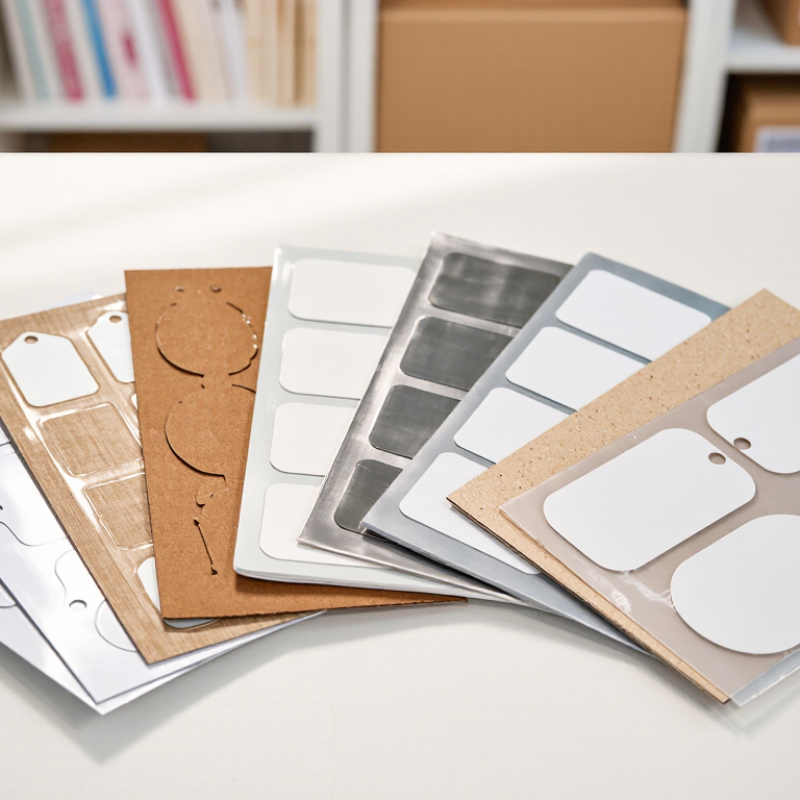
A4 adhesive labels differ mainly by face material and adhesive behavior. The right pairing affects print quality, shelf life, and application speed. Matte paper with permanent adhesive suits cartons, folders, and warehouse bins. Gloss paper with permanent adhesive gives sharper images for product information. Recycled paper with removable adhesive works well for temporary files, though its surface can shed fibers. Coated paper with removable adhesive supports short-term promotions and event materials. Keep it practical.

Polypropylene with permanent adhesive resists water, oil, and frequent handling. Polypropylene with removable adhesive fits reusable containers and changing inventory tags. Flexible polyethylene with low-temperature adhesive follows curved bottles and chilled packaging. Polyester with permanent adhesive handles heat, abrasion, and long-term equipment identification. Clear film with permanent adhesive creates a nearly invisible look on glass or smooth plastic. Vinyl with outdoor-grade permanent adhesive suits exposed signs, but surface preparation remains critical. These are ten useful combinations, not universal answers.

Tips: Test labels on the actual surface for 24 hours. Check adhesion after cooling, rubbing, and moisture exposure. A label that sticks well in the office may fail in a cold warehouse. I have seen attractive paper labels curl after one damp shift. That mistake is easy to repeat. Measure the printer margin, sheet thickness, and corner radius before ordering. Also review whether the adhesive needs clean removal; “removable” performance changes with time, pressure, and temperature.

How A4 Adhesive Labels Differ in Printing, Durability, and Application

Top 10 Types of A4 Adhesive Labels for Global Buyers

A4 adhesive labels vary widely in printing quality, durability, and intended use.

Multipurpose paper labels suit invoices, files, and short-term shipping.
Matte labels reduce glare and support clear office printing.
Glossy labels produce sharper images but may show fingerprints.
Colored labels improve sorting and visual warnings.
Transparent labels create a clean appearance on glass or plastic.
Removable labels support temporary identification without leaving heavy residue.
Permanent labels provide stronger bonding for long-term storage.
Waterproof labels resist splashes and humid handling.
Freezer labels remain stable under cold storage conditions.
Recycled-paper labels support sustainability goals, but their surface may print less evenly.

Printing performance depends on the face material, coating, printer type, and ink or toner.

Laser printing often gives crisp text and strong smudge resistance. Inkjet printing can create vivid colors, but uncoated paper may absorb ink. Always check sheet alignment before printing. A small margin error can waste a full A4 sheet. Test before volume buying.

Durability also depends on the application surface.

Clean, dry cardboard accepts labels more easily than dusty plastic. Curved containers may require flexible stock and stronger adhesive. Heat, moisture, friction, and sunlight can shorten service life.

In practical checks, labels sometimes pass printing tests but fail during peeling or transport. That detail matters.

Buyer specifications should include label size, adhesive strength, storage temperature, and expected service period. The cheapest option is not always the most reliable.

Choosing the Right A4 Adhesive Label for Different Global Uses

Top 10 Types of A4 Adhesive Labels for Global Buyers

Choosing the Right A4 Adhesive Label for Different Global Uses

Choosing an A4 adhesive label starts with the surface, printer, and handling conditions. The ten common options include permanent paper, removable paper, waterproof film, freezer-grade, thermal transfer, direct thermal, laser, inkjet, recycled-content, and security labels.

Permanent paper suits cartons and office files. Removable paper works better for temporary pricing or event materials. Waterproof film protects labels exposed to splashes, while freezer-grade adhesive must remain stable on cold packaging. Thermal transfer labels support durable text and barcodes. Direct thermal labels are convenient, but heat and sunlight can darken them unexpectedly.

Printer compatibility matters more than appearance. Laser sheets need controlled adhesive coating and accurate edge construction. Inkjet sheets require absorbent surfaces to prevent feathering.

For international shipments, test the label on corrugated board, plastic, and coated cartons. Adhesion can change after 24 hours.

Smithers’ The Future of Global Printed Labels to 2028 estimates the global printed-label market will grow from about $45.8 billion in 2023 to $54.1 billion in 2028. FINAT’s 2024 Radar reported weaker European self-adhesive label demand in 2023, making material waste harder to justify.

A cheaper sheet is not always economical. I have found that small corners lift first. Humidity exposes weaknesses.

Check liner release, barcode readability, and storage temperature before ordering. Regional recycling systems also differ, so recycled-content labels need practical verification, not only a marketing claim.

Key Buying Standards for A4 Adhesive Labels in International Markets

Top 10 Types of A4 Adhesive Labels for Global Buyers

Global buyers should judge A4 adhesive labels by performance, not a glossy sample. Common formats include paper, synthetic, removable, permanent, freezer-grade, thermal, clear, fluorescent, recycled, and security labels. Smithers’ 2024 report, The Future of Labels and Release Liners to 2028, valued the global label market at roughly US$50 billion in 2023. That scale makes supplier verification essential.

Ask for 210 × 297 mm dimensional tolerances, adhesive peel data, liner quality, and print compatibility. Face stock should match inkjet, laser, or thermal equipment. Adhesive selection depends on glass, cardboard, plastic, temperature, and expected shelf life. ASTM D3330 peel testing can support comparable results. ISO 12647 guidance also helps control printed colour across international production sites. Do not accept vague terms like “strong glue” or “premium paper.”

International purchasing also requires chemical and packaging compliance for the destination market. Request current safety documentation, material declarations, batch traceability, and storage instructions. Test labels after humidity exposure, cold storage, abrasion, and repeated handling.

Samples lie. Sometimes.

Grand View Research projects the pressure-sensitive labels market to grow at about 5.8% annually from 2024 to 2030. Buyers should still challenge optimistic forecasts. A label that performs well in a dry warehouse may curl in a humid port.

My practical preference is a controlled pilot: print one full A4 sheet, apply it to the real surface, and inspect adhesion after 24 and 72 hours. Reliability is proven in conditions, not promised in quotations.