

Blog
Blog
Blog
What Are the Top ESD Latex Gloves for Global Buyers?
Choosing the right Esd Latex Gloves is not simply a matter of comparing prices or package photos. Global buyers must examine electrical performance, material quality, comfort, and supplier reliability together. A glove may appear suitable in a product image, yet fail to perform consistently across different production environments.
In electronics assembly, small details matter. Finger sensitivity affects component handling. A loose cuff can expose the wrist. Excessive latex thickness may reduce control when placing tiny connectors. Powder-free designs can help reduce workplace contamination, while tested surface resistance provides more useful evidence than broad marketing claims. Buyers should request technical data, test conditions, sample pairs, and production records before approving large orders.
There is no universal winner.
The best Esd Latex Gloves depend on the application, climate, hand size, and required protection level. Experienced purchasing teams often compare several samples under real working conditions. They check grip after repeated use, seam comfort, odor, elasticity, and packaging stability during shipping. These practical observations can reveal weaknesses that laboratory figures do not show.
Supplier evaluation also deserves careful attention. Reliable manufacturers should explain their testing methods, quality controls, material composition, and traceability process. Independent verification can strengthen confidence, but it should not replace direct product inspection. Some published specifications may be incomplete or difficult to compare. That is where buyers must pause and ask better questions.
This guide explores the leading selection factors for Esd Latex Gloves, helping international purchasers balance performance, worker comfort, compliance expectations, and long-term supply reliability.
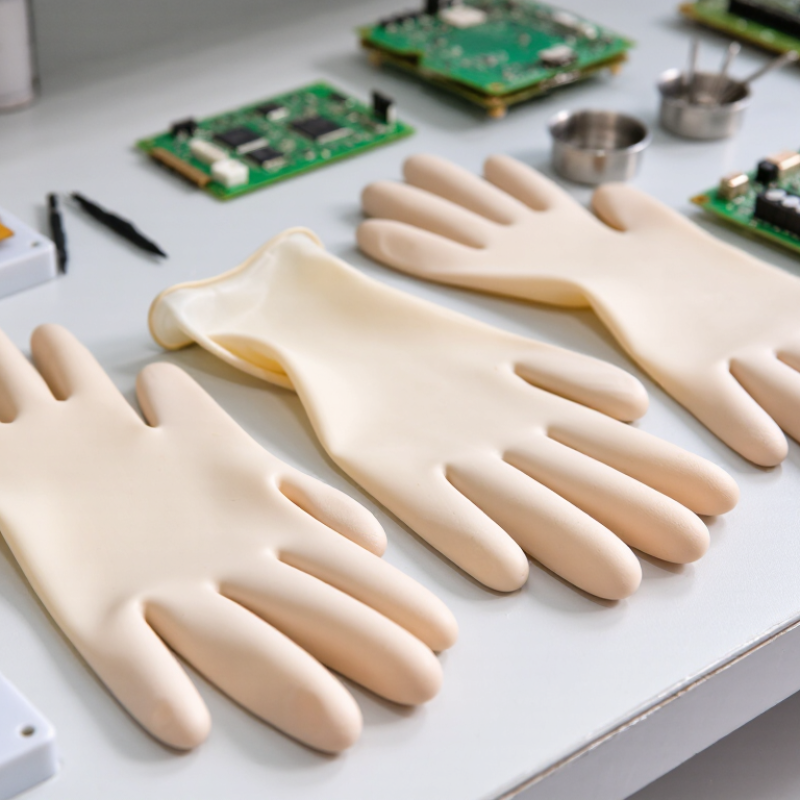
Understanding ESD Latex Gloves and Their Protective Role
What Are the Top ESD Latex Gloves for Global Buyers?
ESD latex gloves help reduce static charge during electronics assembly, inspection, and clean handling. Their protective role is often misunderstood. Latex itself is usually insulating, so ESD performance comes from conductive fibers, coatings, or engineered materials within the glove. These features allow charge to move away from sensitive components when the worker uses a complete grounding system.
The glove is only one part of protection. Wrist straps, ESD footwear, grounded workstations, and humidity control also matter. A glove may show acceptable resistance in a laboratory but perform differently after repeated washing, stretching, or exposure to oils. Buyers should request test methods, resistance ranges, material details, and batch traceability. Standards such as IEC 61340-5-1 can guide evaluation, but local requirements may differ.
Fit matters greatly. Loose fingertips can catch small connectors, while tight latex may tear near the thumb. A textured palm can improve grip on circuit boards and metal housings. Check dexterity, thickness, cuff length, and powder-free construction. Latex allergy risks also require careful review, especially in workplaces with long shifts. A low resistance reading alone can mislead. Real protection depends on the glove, the worker, and the entire ESD program. That point is easy to overlook.
What Are the Top ESD Latex Gloves for Global Buyers? - Understanding ESD Latex Gloves and Their Protective Role
| ESD Latex Glove Type | Typical Surface-Resistance Range* | Typical Thickness | Main Protective Role | Best-Fit Applications | Important Buyer Checks |
|---|---|---|---|---|---|
| Carbon- or conductive-fiber latex gloves | Approximately 106–109 Ω when tested under specified conditions | About 0.10–0.20 mm | Helps dissipate static charge from the glove surface and reduces charge accumulation during handling | Printed circuit board assembly, semiconductor handling, precision electronics and clean production areas | Request lot-based resistance data; verify fiber uniformity, surface resistance after washing or aging, and compatibility with the facility grounding system |
| Antistatic-coated latex gloves | Commonly designed for the dissipative range of approximately 106–1010 Ω | About 0.10–0.18 mm | Provides a conductive or dissipative outer surface to limit triboelectric charge generation | General electronics assembly, inspection, optical components and low-contamination work | Check coating durability, flaking or transfer risk, resistance uniformity across palm and fingers, and whether the coating is compatible with cleanroom requirements |
| Powder-free ESD latex examination gloves | Often specified around 107–1010 Ω; actual performance depends on the ESD treatment | About 0.10–0.15 mm | Combines low particulate shedding with static-control performance for sensitive handling | Clean assembly, laboratory inspection, medical-device production and component packaging | Confirm powder-free status, extractable residues, endotoxin or particulate requirements where applicable, and latex-protein warnings |
| Textured-fingertip ESD latex gloves | Typically within approximately 107–1010 Ω if the texture is formed with an ESD-capable compound | About 0.12–0.22 mm | Improves grip while helping control electrostatic charge during repeated component handling | Small-part assembly, cable work, mechanical-electronic integration and inspection tasks | Evaluate grip in dry and lightly contaminated conditions, fingertip texture consistency, abrasion resistance and possible surface marking |
| Long-cuff ESD latex gloves | Usually targeted at approximately 106–1010 Ω across the hand and cuff, subject to test method | About 0.15–0.30 mm | Extends static-control coverage toward the wrist and reduces exposed-skin contact with components | Controlled assembly lines, enclosure integration, battery-module work and contamination-sensitive handling | Check cuff length, seam strength, sleeve overlap, wrist comfort, heat retention and whether the full glove-to-cuff path remains dissipative |
| Cleanroom-compatible ESD latex gloves | Commonly specified in the dissipative range of approximately 106–1010 Ω | About 0.10–0.18 mm | Controls static charge while minimizing particles and residues in controlled environments | Semiconductor, display, optics, pharmaceutical-device and high-cleanliness production | Ask for particle-shedding, ionic-residue, nonvolatile-residue and packaging data; confirm the required cleanroom class and sterilization compatibility |
Key Performance Criteria for Comparing ESD Glove Options
When global buyers compare ESD latex gloves, resistance control should lead the evaluation. Latex alone does not guarantee electrostatic protection. Manufacturers should provide measured surface resistance, charge decay data, and test conditions. Request testing methods aligned with recognized ESD standards, such as IEC 61340-5-1. Ask whether testing covers dry and humid environments. Humidity changes glove behavior. A glove can pass in a factory laboratory yet perform differently on a dry assembly line.
Fit directly affects ESD performance and operator accuracy. Wrinkles, loose cuffs, or stretched fingertips can reduce contact with grounding systems. Compare size consistency, elastic recovery, grip, and finger sensitivity during realistic tasks. Test with small screws, smooth connectors, and packaging films. Do not judge by appearance. Powder-free construction helps protect sensitive surfaces and reduces residue. Buyers should also review latex allergen controls, washing processes, and cleanroom requirements. These details are easy to overlook.
Reliable sourcing depends on traceability. Request batch numbers, inspection records, shelf-life information, and packaging specifications. Check whether each shipment includes current conformity documents, not recycled paperwork. For high-volume programs, compare failure rates, replacement policies, and delivery stability. The cheapest glove may create hidden downtime. I would still challenge every supplier’s test claim with independent sampling. One small trial is not enough. Repeat testing after storage and repeated donning. Results may be less perfect than the brochure suggests.
Main ESD Latex Glove Types and Their Industrial Applications
Global buyers usually choose ESD latex gloves by surface resistance, fit, and task demands. Powder-free latex gloves suit electronics assembly, where loose particles can damage circuit boards. They offer a flexible grip for small screws, wires, and delicate connectors. Palm-coated versions improve handling during repetitive work. Finger-coated types provide better fingertip control for inspection and micro-assembly. Cleanroom-grade options reduce particle shedding in semiconductor and precision optical areas. Some models include conductive fibers, while others rely on dissipative latex compounds. Their performance can vary with humidity, washing, and skin contact.
Tips: Request test data for surface resistance and verify the testing method. Check alignment with IEC 61340-5-1 or relevant local requirements. Confirm sizes with real workers, not only a supplier chart. A loose cuff can expose sensitive parts to body-generated charge. Latex allergies also require careful screening and alternative materials. Do not assume a darker glove performs better. It may only contain a different pigment. Packaging matters, too; sealed bags help preserve cleanliness during international shipping.
In production checks, buyers should test gloves after storage, repeated use, and contact with common work surfaces. One laboratory result is not enough. A glove can pass before use but fail after stretching or contamination. This is an easy detail to overlook. Buyers should record batch numbers, resistance results, and replacement intervals. The best type is not always the most conductive one. It must balance ESD control, dexterity, cleanliness, comfort, and worker safety for the actual application.
What Are the Top ESD Latex Gloves for Global Buyers?
Main ESD latex glove types are commonly differentiated by electrical resistance. The chart uses the IEC 61340 resistance classes as a technical reference: conductive materials are below 10⁴ Ω, dissipative materials range from 10⁴ to below 10¹¹ Ω, and insulating materials are 10¹¹ Ω or higher.
Used for applications requiring rapid charge dissipation, such as sensitive electronic assembly and component handling. They should be used with a verified grounding path.
The most common ESD-oriented choice for electronics manufacturing, semiconductor packaging, laboratory work, and controlled cleanroom environments.
Provide physical protection but do not control static charge by themselves. They are unsuitable as the sole ESD-control measure unless tested and integrated into a complete program.
Resistance values are classification boundaries rather than brand or market-share data. Actual glove performance depends on material formulation, humidity, surface contamination, testing method, and grounding practice. Buyers should request lot-specific resistance and compliance test results.
Supplier Evaluation, Certifications, and Regional Requirements
What Are the Top ESD Latex Gloves for Global Buyers?
The best ESD latex gloves combine stable electrical performance, clean manufacturing, and dependable fit. Buyers should request surface resistance data, tested under defined humidity and temperature conditions. A serious supplier can provide recent laboratory reports, batch traceability, and an AQL inspection record. Check whether the testing covers the finished glove, not only the raw latex. That detail is often missed.
Certifications must match the intended market and application. IEC 61340-5-1 or ANSI/ESD S20.20 can support an ESD control program, but they do not automatically certify every glove. For European sales, review PPE Regulation (EU) 2016/425, applicable EN standards, CE documentation, and chemical restrictions.
Medical applications may require separate evidence under local medical-device rules. In the United States, medical claims can require appropriate FDA compliance. Latex allergy warnings also need careful regional review. Requirements differ. Assumptions create risk.
Tips:
Ask for three recent production samples. Measure resistance after wearing and after storage. Confirm powder-free processing, packaging cleanliness, size consistency, and carton labeling. Request proof of factory quality controls and corrective-action records. A supplier may offer impressive certificates, yet weak humidity testing can expose poor ESD stability. I would also compare samples from different lots, because one successful test is not enough. Good evaluation takes time.
A Step-by-Step Selection Process for Global Buyers
Global buyers need more than a glove labeled “ESD.” Selection should follow the work area, handling risks, and verification records. Begin by defining the task. Will workers handle circuit boards, polished parts, or small connectors? Check required dexterity, latex thickness, cuff length, and powder-free construction. Latex offers comfortable stretch and tactile control, but it may not suit workers with latex sensitivity.
Review technical evidence next. Ask for surface resistance data, test conditions, and recent batch reports. A useful glove should support controlled charge dissipation, not merely claim antistatic performance. Compare results with recognized electrostatic-control requirements, such as IEC 61340-5-1, when applicable. Test the glove with wrist straps, footwear, flooring, and workstations. Isolated glove testing can mislead buyers.
Then inspect production and delivery details. Confirm size consistency, packaging cleanliness, shelf-life information, and traceability. Request samples from several sizes and wear them during a realistic shift. Note finger fatigue, sweat buildup, cuff slippage, and grip on smooth components. Small failures matter. In purchasing trials, a glove passed resistance testing but caused frequent adjustments at the bench. It was technically suitable, yet operationally poor. That experience changed our checklist.
Consider regional documentation and worker training before approval. Requirements can differ across industries and countries. Keep test records, supplier declarations, and internal evaluation notes together. A lower price may look attractive, but unstable sizing or unclear test data can increase total cost. Verify every claim carefully.