

Blog
Blog
Blog
Top 10 Types of Upholstery Supplies for Global Buyers
Choosing the right upholstery supplies can shape a product’s comfort, durability, appearance, and final cost. Global buyers often compare more than fabric samples. They examine foam density, stitching strength, fire performance, packaging quality, and delivery consistency. A beautiful textile means little if it fades quickly or arrives damaged. Small details matter.
This guide introduces ten practical categories used across furniture manufacturing, repair workshops, hospitality projects, and interior design. They include upholstery fabrics, foam, batting, webbing, springs, adhesives, sewing threads, needles, zippers, and finishing tools. Each category serves a different purpose. Together, they support the complete upholstery process, from a wooden frame to a finished chair.
Real sourcing experience shows that specifications must be checked carefully. A supplier may describe foam as “high quality,” but buyers still need density and firmness data. Fabric images can also hide differences in texture, color, and backing. Samples remain essential. No list is perfect. Project conditions vary by climate, furniture type, budget, and customer expectations.
Reliable suppliers should provide clear product details, consistent samples, transparent packaging information, and responsive technical support. Buyers should also review shipping requirements, minimum order quantities, testing documents, and replacement policies. These checks reduce costly surprises. They do not remove every risk.
The following overview helps international purchasers compare upholstery supplies with greater confidence. It focuses on practical use, material performance, and purchasing considerations. The goal is not simply to find the lowest price. It is to select dependable materials that perform well after installation, daily use, cleaning, and transport.
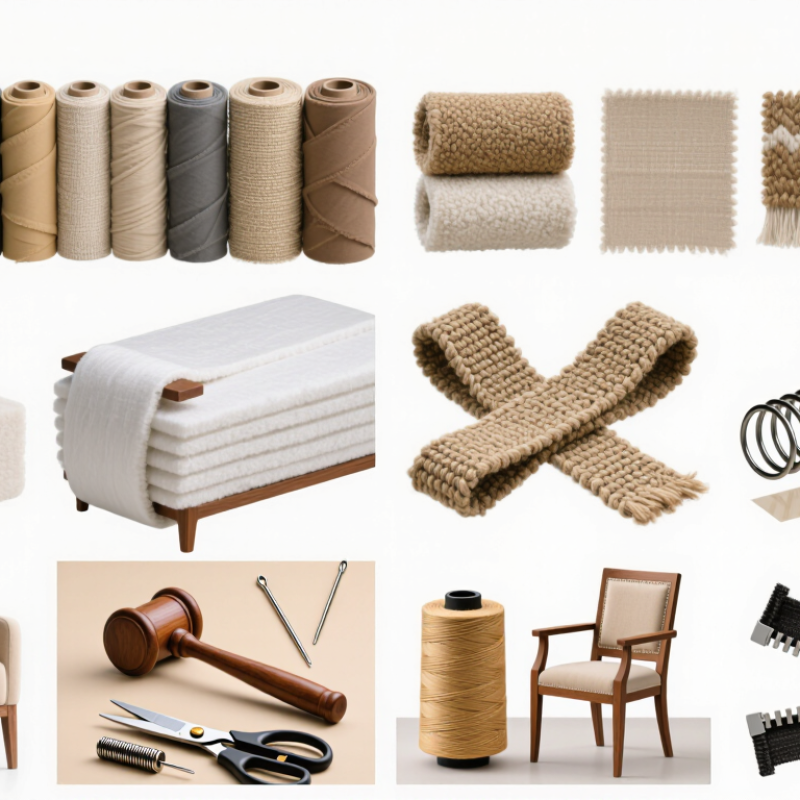
Upholstery Supply Categories: Fabrics, Foams, Fillings, Frames, and Hardware
Global upholstery buyers usually source ten core supplies: upholstery fabrics, coated textiles, foam, polyester fiberfill, natural fillings, timber frames, metal frames, webbing, springs, and fastening hardware. Each category affects comfort, durability, safety, and production cost. Fabric selection should consider abrasion resistance, colorfastness, cleaning methods, and climate. In humid regions, breathable covers can reduce moisture retention. In dry areas, tightly woven fabrics may limit dust penetration.
Foam needs careful attention to density, firmness, recovery, and thickness. A showroom sample can feel comfortable but perform poorly after months of use. Fiberfill adds softness, while layered batting can improve surface shape. Natural fillings offer a different hand feel, yet they may require stronger moisture controls and clearer care instructions. Frames should have stable joints, accurate dimensions, and suitable moisture content. Metal frames can support modern forms, but their welds and protective finishes deserve inspection.
Webbing and springs influence seat support more than many buyers expect. Hardware includes clips, staples, hinges, brackets, zippers, and decorative fasteners. Small failures create expensive repairs. Details matter. Buyers should request material specifications, production samples, traceable test reports, and consistency records before placing large orders. Requirements vary by market, so regional fire, chemical, labeling, and recycling rules need verification. My own sourcing mistake was trusting a specification sheet without testing assembled samples. The materials were acceptable individually, but the finished cushion lost shape too quickly. Procurement teams should evaluate the complete upholstery system, not isolated components.
Textile Selection by Fiber Content, GSM, Abrasion Ratings, and ISO 12947 Testing
For global upholstery buyers, fabric selection starts with fiber content, not appearance alone.
Polyester offers consistent color and practical moisture resistance. Nylon improves resilience in busy seating, while cotton adds softness but may wrinkle or absorb spills. Blended constructions can balance comfort, cost, and dimensional stability.
Check the technical sheet, then inspect a physical swatch under showroom and daylight. Small differences matter.
GSM
indicates fabric weight per square meter and helps predict hand feel, coverage, and construction density. A higher GSM is not automatically stronger. A heavy, loosely woven fabric can wear faster than a lighter, tight weave.
Ask for weave details, backing information, shrinkage data, and batch tolerances.
I have seen attractive samples fail after installation because the foam and fabric stretched differently. That mistake is expensive.
Abrasion ratings provide a useful comparison for seating applications.
ISO 12947 testing, commonly known as the Martindale method, measures resistance under controlled rubbing cycles. Use the reported result with care. Test pressure, endpoint, yarn structure, and specimen preparation affect interpretation.
Request the full test report, not only a cycle number. Compare it with expected use: a hotel lobby, family sofa, and occasional chair need different thresholds.
Laboratory results guide decisions, but sunlight, cleaning, sharp clothing, and poor upholstery technique remain outside the test. Recheck assumptions before ordering bulk fabric.
Good sourcing is rarely perfect.
Foam and Filling Standards: ILD, Density, Resilience, and CAL 117 Compliance
Top 10 Types of Upholstery Supplies for Global Buyers
Foam selection begins with measurable performance, not softness alone. ILD, or indentation load deflection, shows the force needed to compress foam to a stated percentage. ASTM D3574 measures IFD at 25% compression. A higher ILD usually feels firmer, but temperature and fabric tension can change the result. Do not compare figures from different test methods.
Density indicates foam weight per volume, not firmness. General seating foam often falls near 25–35 kg/m³, while heavy-use cushions may require higher values. ASTM D3574 includes separate density, compression-set, and resilience tests. Resilience describes recovery after impact. Flexible seating commonly targets strong rebound, yet high resilience alone cannot guarantee long service life. A cushion may bounce well and still collapse early.
The California Bureau of Household Goods and Services identifies TB 117-2013 as a smolder-resistance standard for upholstered components. It is not a universal “fireproof” claim. Buyers should request component test reports, material descriptions, and production-lot traceability. CAL 117 documentation must match the actual foam, filling, barrier, and cover combination. Substituting one layer can invalidate the evidence. In supplier audits, I have seen density certificates with no batch number. That gap matters. It weakens traceability. ASTM methods improve comparison, but they do not replace application testing. A laboratory result is useful; a complete purchasing specification is better.
Top 10 Types of Upholstery Supplies for Global Buyers
Foam and Filling Standards: ILD, Density, Resilience, and CAL 117 Compliance
The chart shows representative midpoints of commonly specified performance ranges for upholstery foam. Density is measured in kg/m³, ILD indicates firmness in pounds-force, and resilience represents the percentage of energy returned after compression.
CAL 117 compliance is a pass/fail result determined by testing the complete upholstered construction, including the cover, barrier, foam, and other components. It is not an inherent property of a foam type, so buyers should request test reports for the final product configuration.
Structural Materials and Hardware: Timber Grades, Load Ratings, and Corrosion Classes
Top 10 Types of Upholstery Supplies for Global Buyers
Structural materials and hardware determine whether upholstered furniture stays stable after years of use. In my purchasing checks, I examine timber grade, moisture content, joint design, and visible defects. Kiln-dried hardwood often suits heavily used frames, while graded softwood can work for lighter applications. Grade names differ between countries, so buyers should request the applicable standard and inspection report. Measure twice.
A load rating must describe the complete assembly, not one metal bracket. Ask whether testing covers static weight, repeated movement, impact, or side pressure. A chair used in a hotel lobby faces different stress than a decorative bedroom bench. Confirm the safety factor, test duration, fixing method, and fastener size. A neat spreadsheet can still mislead. I have seen strong components fail because screws entered weak timber or missed the load path.
Corrosion class matters when hardware meets humidity, cleaning chemicals, or salt air. Lower indoor-risk environments may suit basic protected steel, while coastal, commercial, or frequently washed spaces require higher corrosion resistance. Check the declared class, coating thickness, salt-spray evidence, and cut-edge protection. Stainless steel is not automatically suitable for every environment or load. Small hinges, corner plates, bolts, and staples should share compatible materials, or galvanic corrosion may appear around damp joints. Labels can mislead. Always match the specification to the furniture’s real location and maintenance routine.
Global Buying Criteria: REACH, CPSIA, MOQ, Lead Times, and Incoterms
Global buyers of upholstery supplies often compare fabric, leather, foam, webbing, thread, fasteners, zippers, adhesives, and filling materials. Compliance must start before sampling. The European Chemicals Agency’s Candidate List contained 247 substances in June 2024. Ask suppliers for updated REACH declarations, test reports, and material composition records. Do not accept a recycled certificate from an old order. It may no longer match the current batch.
CPSIA deserves careful interpretation. It applies mainly to products intended for children, with a 100 ppm limit for total lead and a 90 ppm limit for lead in surface coatings. Upholstery components used in children’s furniture may therefore require accredited laboratory testing and traceable production records. The U.S. Consumer Product Safety Commission requires supporting compliance documentation. For ordinary commercial furniture, buyers should still check local chemical and flammability rules. One rule rarely covers every market.
MOQ and lead time affect the landed cost more than many buyers expect. Use a written quote showing MOQ by color, size, and material grade. Confirm sample approval, production days, inspection time, and buffer stock. UNCTAD’s Review of Maritime Transport reports that maritime shipping carries over 80% of global merchandise trade by volume, so port delays matter. Choose Incoterms carefully. FCA can provide clearer freight control, while DDP may simplify delivery but hide tax and customs risks. A spreadsheet can still lie. Recheck every assumption.
Related Posts
-
Top 10 Upholstery Supplies You Need for Your Next Project?
-
How to Choose the Best Upholstery Accessories?
-

Why Choosing the Right Sofa Upholstery Fabric Can Transform Your Living Space
-
2025 Top Trends in Furniture Upholstery Fabric You Must Know
-
What is Upholstery Fabrics and How Are They Used in Interior Design?
-

Best Upholstery Fabrics for Global Buyers in 2026?