

Why Choose Embroidery Sheer Fabric for Global Sourcing?
Why Choose Embroidery Sheer Fabric for Global Sourcing?
Embroidery Sheer Fabric combines visual delicacy with practical sourcing potential. Its translucent base creates depth, while stitched motifs add texture, identity, and perceived value. Designers use it for veils, overlays, sleeves, curtains, decorative panels, and lightweight fashion details. The fabric can make a simple silhouette feel more refined.
Textile consultant Deborah Young has said, “Fabric performance matters as much as appearance.” This principle deserves attention during international purchasing. A beautiful sample may still fail during cutting, sewing, washing, or shipping. Buyers should check fiber composition, fabric width, weight, embroidery density, color consistency, and backing stability. Small details matter.
Touch the surface.
A reliable supplier should provide clear technical data, recent samples, production photographs, and realistic lead times. Buyers can request a pre-production sample before confirming larger quantities. Testing for shrinkage, colorfastness, snagging, and seam behavior also reduces avoidable surprises. These steps support better communication across languages and time zones.
Embroidery Sheer Fabric offers strong creative flexibility, but it is not automatically suitable for every market. Dense embroidery can increase weight and cost. Delicate mesh may require careful packaging and skilled handling. Some buyers may focus too heavily on appearance. That is a mistake worth reconsidering. The best sourcing decision balances beauty, performance, price, supply reliability, and responsible production practices. When these factors align, embroidered sheer textiles can support distinctive products without sacrificing practical quality.
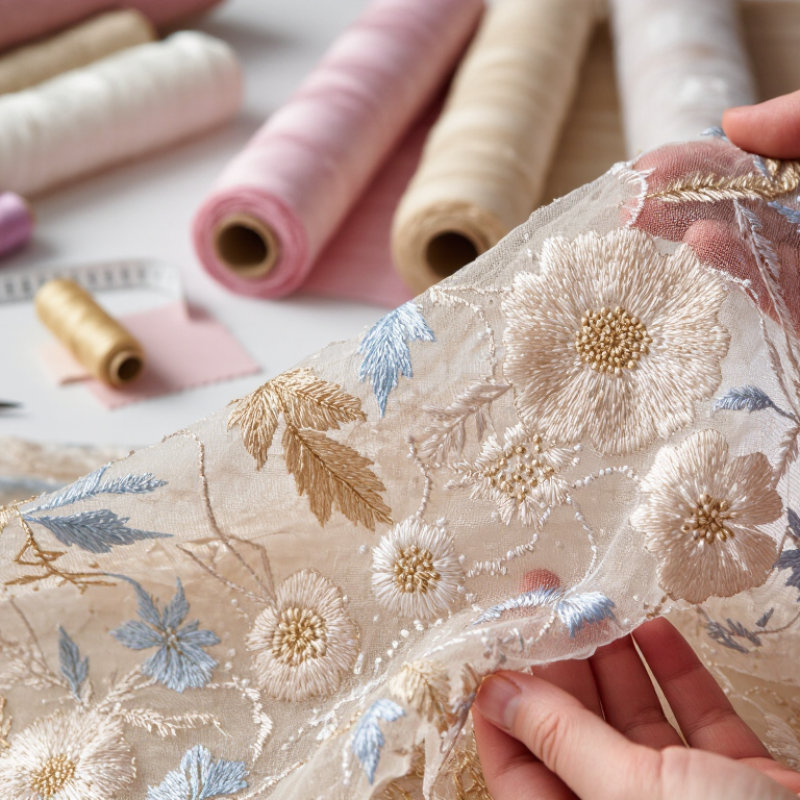
What Is Embroidery Sheer Fabric and How Is It Made?
Embroidery sheer fabric is a lightweight, semi-transparent textile decorated with raised or flat thread designs. Its base may use polyester, nylon, cotton, silk, or blended yarns. Mesh, voile, tulle, and fine organza are common foundations. The open structure creates softness and airflow, while embroidery adds texture and visual depth.
Manufacturing usually starts with knitting or weaving the sheer base. The fabric is then stabilized on a frame or embroidery machine. A digital pattern guides needles across the surface, forming flowers, lines, geometric shapes, or delicate borders. Thread tension matters greatly. Too much tension can pucker the fabric. Too little can create loose stitches and uneven motifs. Finishing may include trimming, washing, pressing, or adding a light backing. In practice, no two batches are perfectly identical. Slight differences can appear around repeated designs.
Tips: Request a physical sample before global sourcing. Check transparency under natural light. Measure width, weight, pattern repeat, and embroidery placement. Rub the surface gently to test snagging. Wash a sample before approval, because shrinkage can change the design. Ask for colorfastness and composition records. A detailed specification sheet prevents avoidable disputes, although it cannot replace careful inspection.
Why Choose Embroidery Sheer Fabric for Global Sourcing? - What Is Embroidery Sheer Fabric and How Is It Made?
| Data Dimension | Typical Specification or Fact | Global Sourcing Relevance |
|---|---|---|
| Basic Definition | A lightweight, semi-transparent textile decorated with stitched motifs, patterns, or borders. | Combines the visual delicacy of sheer fabric with the added texture and detail of embroidery. |
| Common Base Fibers | Polyester, nylon, cotton, rayon, and silk; blended constructions are also used. | Fiber selection affects price, strength, softness, care requirements, and customs documentation. |
| Typical Fabric Structure | Plain weave, net, mesh, voile, chiffon, organza, or tulle base with decorative stitching. | The structure determines transparency, drape, stability, and suitability for apparel or home textiles. |
| Typical Fabric Weight | Approximately 30–150 g/m² for many sheer constructions; dense embroidery can increase the finished weight. | GSM helps buyers compare samples, estimate shipping weight, and confirm the intended level of transparency. |
| Typical Usable Width | Approximately 100–300 cm, depending on the loom, embroidery machine, base fabric, and design placement. | Usable width influences marker efficiency, cutting waste, panel layout, and landed cost. |
| Embroidery Thread Options | Polyester and rayon threads are common; cotton, metallic, and specialty threads may be selected for specific effects. | Thread composition affects colorfastness, sheen, abrasion resistance, wash performance, and compliance testing. |
| Embroidery Density | Light open motifs preserve transparency; dense motifs create more coverage, weight, and surface texture. | Density should be specified with artwork approval because it affects production time, material use, and final appearance. |
| Design Repeat | Designs may be placed as all-over patterns, borders, spaced motifs, or engineered panels. | Repeat size and placement affect garment matching, cutting plans, fabric utilization, and minimum order planning. |
| Production Step 1: Base Fabric Preparation | Yarns are prepared and woven or knitted into a lightweight base fabric, followed by inspection and, when required, dyeing or finishing. | A stable and evenly tensioned base reduces distortion during embroidery. |
| Production Step 2: Artwork Digitization | The approved artwork is converted into stitch instructions, including stitch type, density, sequence, and thread colors. | Digital approval helps control repeat accuracy and reduces costly sampling changes. |
| Production Step 3: Stabilization | A temporary or permanent backing, topping, or support layer may be used to prevent puckering and distortion. | The support method must match the fabric transparency, hand feel, embroidery density, and end-use requirements. |
| Production Step 4: Machine Embroidery | Computer-controlled embroidery machines stitch the design onto the prepared sheer base. | Machine settings, hoop tension, needle selection, and thread tension influence registration and surface quality. |
| Production Step 5: Finishing | The fabric may be washed, heat-set, trimmed, pressed, coated, or finished according to fiber and design requirements. | Finishing can change shrinkage, softness, dimensional stability, color appearance, and care instructions. |
| Dimensional Stability | A practical purchasing specification is often set by testing length and width change after the intended care method; the acceptable limit depends on the product. | Testing before bulk production helps prevent seam distortion, panel mismatch, and unexpected size changes. |
| Colorfastness Checks | Common evaluations include color change after washing, rubbing, perspiration, and light exposure, selected according to end use. | Documented test requirements create consistent quality expectations across international suppliers. |
| Typical Applications | Dresses, blouses, veils, lingerie, scarves, overlays, curtains, decorative panels, and craft products. | The same embroidery concept can serve fashion, interiors, accessories, and seasonal collections. |
| Packaging and Shipping | Rolls are commonly protected with inner tubes, moisture-resistant wrapping, and external packaging suitable for transport. | Packaging should prevent snagging, crushing, moisture exposure, and permanent creasing during long-distance shipment. |
| Key Buyer Approval Items | Fiber content, GSM, usable width, color, transparency, embroidery repeat, stitch density, backing, defects, and care performance. | A written specification and approved reference sample reduce ambiguity between sampling and bulk production. |
Note: The numerical ranges shown are typical industry reference ranges rather than universal limits. Final specifications should be confirmed through a physical sample, technical sheet, and agreed test method.