How to Choose the Best Upholstery Materials?
Choosing upholstery materials is a practical decision, not just a color choice. A fabric that looks elegant in a showroom may wear differently beside a sunny window or a busy family sofa. Consider daily use, cleaning needs, pets, children, and the feel you want under your hand. Small details matter. A tightly woven fabric may resist snags better than a loose weave, while leather can often be wiped clean but may show scratches.
Performance data helps, but it needs context. The Association for Contract Textiles’ Upholstery Fabric Performance Guidelines recommend 30,000 Wyzenbeek double rubs for high-traffic woven upholstery. This is a useful screening measure, not a guarantee of years of service; construction, care, and real-world use also affect durability. Sustainability deserves a closer look, too. Textile Exchange’s Materials Market Report 2024 estimates that global fiber production reached 124 million tonnes in 2023, with polyester making up about 57 percent. That figure covers the wider textile industry, not upholstery alone, but it shows why fiber choice and sourcing questions matter.
The best upholstery materials depend on where the furniture will live and how it will be used. Compare fiber content, abrasion results, cleaning instructions, colorfastness, and supplier documentation before deciding. Ask for a sample. View it in your room’s daylight, then feel it after a few minutes. No single specification tells the whole story, and I would not pretend otherwise. A beautiful fabric can still be the wrong one for a muddy entryway or a sunlit reading chair.
Define Room Use, Exposure, and Performance Needs Before Choosing Upholstery
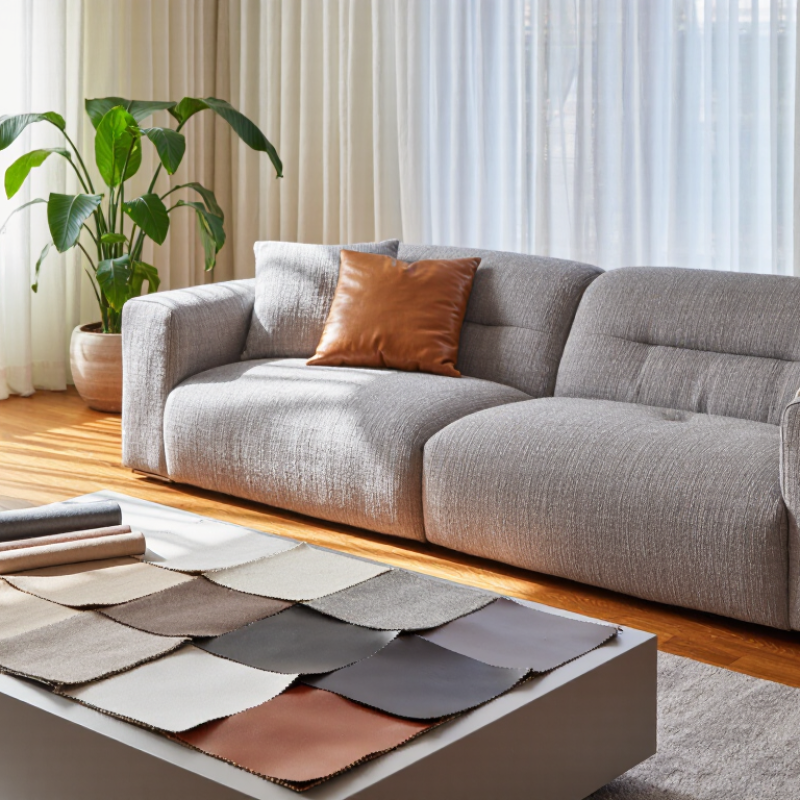
A sofa in a sunny family room faces different demands from an occasional chair in a quiet bedroom. Map how each piece will be used: daily sitting, meals, pets, or damp coats. Then check exposure. South-facing windows can fade cloth, while kitchens expose upholstery to grease and frequent cleaning. A pale, nubby fabric may look inviting, but crumbs can lodge between its loops. That detail matters.
Use performance data to narrow choices, not to predict an exact lifespan. The Association for Contract Textiles’ Performance Guidelines set benchmarks for woven contract upholstery of 30,000 Wyzenbeek double rubs or 40,000 Martindale cycles. The tests use different methods; their numbers are not directly interchangeable. ACT also specifies a minimum grade of 4 after 40 hours in its lightfastness test. For a bright room, ask for the fabric’s test results and consider curtains or a tighter weave. Abrasion scores alone do not measure stain resistance, seam strength, or ease of cleaning.
Match the finish to real care habits. If spills are likely, request cleaning instructions and test a sample with your usual method before ordering. Families sometimes choose the toughest fabric, then dislike its stiff feel. Fair point. Comfort, appearance, and performance can pull in different directions, and no single score settles that choice.
Compare Natural, Synthetic, and Blended Fibers by Key Performance Traits
Natural fibers such as cotton and linen feel breathable and soften with use, but they can wrinkle or absorb spills quickly. Performance depends on weave, yarn, and finish—not just the fiber name. Check construction. The Association for Contract Textiles’ Performance Guidelines set a woven-upholstery benchmark of 30,000 Wyzenbeek double rubs or 40,000 Martindale cycles. These tests help compare abrasion resistance; they do not predict exactly how long a sofa will last in a busy home. Numbers need context.
Synthetic fibers, especially polyester, often resist wear and dry faster, though heat and oily stains can still cause problems. Textile Exchange’s Materials Market Report 2024 estimates polyester made up 57% of global fiber production in 2023. That figure shows its scale, not that every polyester fabric performs well. Blends can combine cotton’s softer hand with polyester’s resilience, but a poor weave can undermine both. I would compare the fabric’s test results, cleaning instructions, and feel against your actual use: a sunny family room differs from a rarely used guest chair. One trade-off is easy to miss: a tightly coated surface may clean well but feel less breathable against bare skin.
Interpret ACT’s 15,000 Wyzenbeek Double-Rub Benchmark for Woven Fabrics
How to Choose the Best Upholstery Materials?
For woven upholstery, ACT’s 15,000 Wyzenbeek double-rub benchmark is a useful starting point, not a promise of long service. ACT lists this level for low-traffic applications; its guidance uses 30,000 double rubs for high-traffic use. The test, based on ASTM D4157, rubs fabric back and forth with a specified abradant. Think of a reading as a lab result, not a calendar: it cannot tell you exactly when a sofa will wear out. That matters.
A fabric rated at 15,000 may suit a rarely used reading chair, while a busy family-room sofa may need a higher rating. But abrasion is only one part of the choice. ACT cautions that Wyzenbeek and Martindale results do not have a reliable direct conversion, so compare fabrics using the same test method. Also inspect the weave, seams, backing, and cleaning instructions. A loose weave can snag on a belt buckle, even when its abrasion number looks reassuring. Numbers help. They are not the whole story. Sit on a sample, check how it feels, and consider pets, sunlight, and daily use. I would not choose by score alone; real rooms are messier than test rigs.
How to Choose the Best Upholstery Materials?
Interpreting ACT’s 15,000 Wyzenbeek Double-Rub Benchmark for Woven Fabrics
How to read this chart: 15,000 double rubs is the ACT benchmark shown here for woven upholstery fabrics. The other bars are multiples of that benchmark for comparison, not test results for specific materials. A higher count alone does not determine suitability; consider the intended use, fabric construction, cleaning requirements, and other performance properties.
Check ASTM Abrasion Methods, Colorfastness, Pilling, and Seam Performance
Choosing upholstery by touch alone can be misleading. Ask for abrasion results and the exact test method. ASTM D4157 measures abrasion with the Wyzenbeek method; ASTM D4966 uses Martindale. Their results are not directly interchangeable. The Association for Contract Textiles (ACT) lists 30,000 Wyzenbeek double rubs or 40,000 Martindale cycles as its high-traffic benchmark. More cycles do not guarantee longer service: weave, backing, cleaning, and test conditions matter too. Ask for the lab report, not just a number.
Color can fade where sunlight falls across an armrest. ACT’s upholstery guidelines specify a minimum grade of 4 for lightfastness after 40 hours under AATCC TM16.3; crocking targets are grade 4 dry and 3.5 wet under AATCC TM8. Pilling deserves a separate check. ASTM D3512 rates surface fuzz and pills after testing, but the rating cannot predict every household’s wear. Look for the method, rating scale, and tested fabric construction.
Seams fail differently from fabric faces. For woven upholstery, ASTM D4034 measures yarn slippage at a seam; request the force and seam-opening result, not a vague “pass.” If possible, inspect a sewn sample under tension. A neat swatch can hide a weak seam. Tests help, but they are snapshots; real use is less tidy.
Match Upholstery Cleaning Codes—W, S, WS, or X—to Care Requirements
An upholstery care code can matter as much as the fabric’s color or texture. Look for the tag beneath a seat cushion or along the sofa frame. W means water-based cleaning is generally suitable. S calls for a solvent-based method, while WS allows either approach. X means vacuuming or gentle brushing only; liquid cleaners may leave stains or damage the fibers.
The codes are useful, not magical. A W-rated fabric may still develop a water ring if it gets too wet. Blot a small spill with a clean white cloth, rather than rubbing it deeper into the weave. For S fabrics, avoid experimenting with household liquids; ask a qualified cleaner about the right solvent method. With WS, test the chosen cleaner on a hidden seam and let it dry fully. Check for color transfer or a change in texture.
X needs extra restraint. Use an upholstery attachment to lift crumbs and dust, and leave wet cleaning to a professional who can assess the fabric. I used to assume a removable cushion cover could be washed like clothing. That was careless; the tag may apply to the cover’s fabric, but shrinkage and backing can complicate things. Read the full care label, and check with the furniture maker or a cleaning professional when its instructions are unclear.